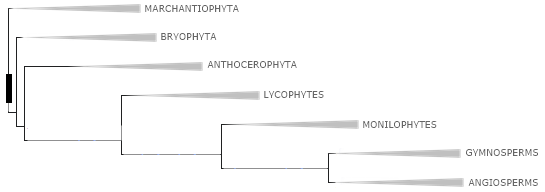
The Embryophyta, or land plants, are the most familiar group of green plants that comprise vegetation on Earth. Embryophytes have a common ancestor with green algae, having emerged within the Phragmoplastophyta clade of green algae as sister of the Zygnematophyceae. Living embryophytes therefore include hornworts, liverworts, mosses, lycophytes, ferns, gymnosperms and flowering plants. The tree below is one of the most consensual about the evolution of the group (Wikipedia). Bryophyta s.l. are a proposed taxonomic division containing three groups of non-vascular land plants (embryophytes): the liverworts, hornworts and mosses.
MARCHANTYOPHYTA
Liverworts has (87:386/)7,273 spp. worldwide (Lars Söderström et al., PhytoKeys, 2016).
Colombia has (37:134/)703 spp. (37ᴱ, Catálogo de Plantas y Líquenes de Colombia/CPLC, 2016), Brazil has (40:131/)709 spp. (114ᴱ, Reflora, 2023). Brazil has 3 families unrecorded in Colombia (Chonecoleaceae, Oxymitraceae, Sphaerocarpaceae), and Colombia has one family uncolected in Brazil (Pseudolepicoleaceae). Mexico includes (122:)592 spp. and varieties in this class (Delgadillo-Moya, Revista Mexicana de Biodiversidad, 2014).
By Hallingbäck & Hodgetts (Mosses, Liverworts, and Hornworts, 2000), endemic genera occur in northern Andes (7), Amazonia (5), Guianan Highlands (4), SE Brazil (2, Pluvianthus, Vittalianthus), and Chocó (1). Geocalycaceae is placed under Lophocoleaceae in CPLC, and Solenostomataceae under Jungermanniaceae.
MARCHANTYOPHYTA
Mosses has 12,505 spp. worldwide (Catalogue of Life).
Colombia has (65:261/)932 spp. (52ᴱ, Catálogo de Plantas y Líquenes de Colombia/CPLC, 2016), Brazil has (74:284/)899 spp. (233ᴱ, Reflora), and Mexico has (75:325/)984 spp. (Delgadillo-Moya, Revista Mexicana de Biodiversidad, vol.85, 2014).
By Hallingbäck & Hodgetts (Mosses, Liverworts, and Hornworts, 2000), endemic genera occur in central Andes (12), Mexico (7), SE Brazil (5, Cladostomum, Crumuscus, Itatiella, Moseniella, Paranapiacabaea), northern Andes (4), West Indies (3), America Central (2), Amazonia (2), and Guianan Highlands (2).
ANTHOCEROPHYTA
Hornworts has (6:12/)213 spp. worldwide (Lars Söderström et al., PhytoKeys, 2016).
ANTHOCEROTACEAE (2/78)
Anthoceros (60, BR), Folioceros (18, BR).
DENDROCEROTACEAE (4/70)
Dendroceros (41, BR), Megaceros (11), Nothoceros (10, BR), Phaeomegaceros (8).
PHYMATOCEROTACEAE (1/2)
Phymatoceros (2, BR).
NOTOTHYLADACEAE (1/22)
Notothylas (22, BR).
PHAEOCEROTACEAE (3/40)
Mesoceros (2), Paraphymatoceros (4), Phaeoceros (34, BR).
LEIOSPOROCEROTACEAE (1/1)
Leiosporoceros (1).
Gradstein (Caldasia, 2018) cites (4:7/)15 spp. in Colombia. Brazil has (4:7/)18 spp. (Anthoceros-4, Folioceros-1, Dendroceros-3, Nothoceros-2, Notothylas-5, Phaeoceros-2, Phymatoceros-1, 3ᴱ, Reflora, 2023). Notothyladaceae has identical genera in both countries. Dendrocerotaceae has a genus in Colombia unrecorded in Brazil (Phaeomegaceros); Brazil has one genus in Anthocerotaceae unrecorded in Colombia (Folioceros) - and both countries has a exclusive family against the other: Phymatocerotaceae (Phymatoceros) in Brazil, and Leiosporoceroaceae (Leiospoceros) in Colombia. Mexico has (3:3/)9 spp. in this class, among Anthoceros (6), Nothoceros (1) and Phaeoceros (1) (Delgadillo-Moya, Revista Mexicana de Biodiversidad, 2014).
LYCOPODIOPSIDA
Lycophyta are a group of vascular plants, one of the oldest lineages of extant vascular plants, containing extinct plants that have been dated from the Silurian (ca. 425 M years ago); also were some of the dominating plant species of the Carboniferous period, and included the tree-like Lepidodendrales, some of which grew over 40m in height, although extant lycophytes are relatively small plants (Wikipedia). Lycophytes and Monilophytes are sucessive sisters of Gymnosperms and Angiosperms (Home et al., Freie University, 2022).
All data below follows the World Ferns website.
LYCOPODIALES
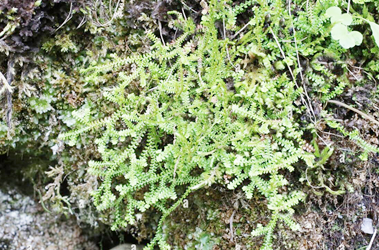
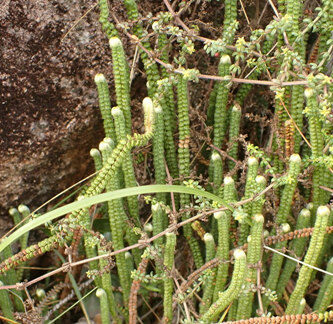
A single family, Lycopodiaceae, with (17/)492 spp. worldwide. Largest diversities in New World among species belongs Colombia (8/94, 75 in Phlegmariurus), Brazil (9/62), USA (8/23, 1/3 in Huperzia) and Mexico (6/23, 17 in Phlegmariurus). Brazil leads Mexico in all Mexican genera except tied status in Lycopodium (1 ✕ 1), and lose in Huperzia (2 ✕ 1). Brazil leads Colombia in all Colombian genera except tied status in Lycopodiella (4 ✕ 4), Austrolycopodium (1 ✕ 1), Diphasium (1 ✕ 1), Lycopodium (1 ✕ 1) and lose in Palhinhaea (9 ✕ 6) and Phlegmariurus (75 ✕ 39).
LYCOPODIELLOIDEAE
(5/)57 spp. in Brownseya (1, Australia, Papuasia, New Zealand, New Caledonia), Lateristachys (3, Philippines, Australia, New Zealand), Lycopodiella (12, holarctic and tropical America, six in USA, 4 in Colombia and 4 in Brazil, none in Mexico), Palhinhaea (25, pantropical, 9 in Colombia, 6 in Brazil, 1 in Mexico, 1 in USA) and Pseudolycopodiella (16, widely scattered worldwide, 7 in Brazil, 3 in Colombia, 2 in USA, 1 in Mexico).
LYCOPODIOIDEAE (9/45)
Nine genera, namely Lycopodiastrum (1, Asia), Pseudodiphasium (1, Asia, Australia, New Zealand), Pseudolycopodium (1, Australia, New Zealand, New Caledonia), Dendrolycopodium (5, 3 in USA and 2 in E Asia), Spinulum (2, over Europe, Caucasus, Turkyie, Russian Far East, Kazakhstan, China, Mongolia, North & South Korea, Japan, one up to Alaska to S USA), Austrolycopodium (7, temperate southern hemisphere, mostly circumantarctic, one to tropical Africa, Brazil and Colombia one each),Diphasiastrum (7, temperate northern hemisphere, 5 in USA, one in South Africa and Madagascar, two to tropical America, namely D. thyoides widely from Mexico to Uruguay, except Chile and West Indies, and D. falcatum endemic to SE Brazil), Diphasium (4, D. jussiaei in Costa Rica to Bolivia and Brazil, D. gayanum Argentina and Chile, D. lawessonianum endemic to Ecuador, and D. cariosum from Philippines and Borneo to New Zealand) and Lycopodium (7, mainly temperate and subarctic regions, three in New World, one continentaly confined to Canada and USA, L. cernua widely in almost all New World, and L. vestitum from Peru and Ecuador, possibly in Venezuela).
HUPERZIOIDEAE
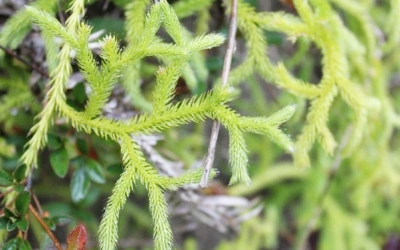
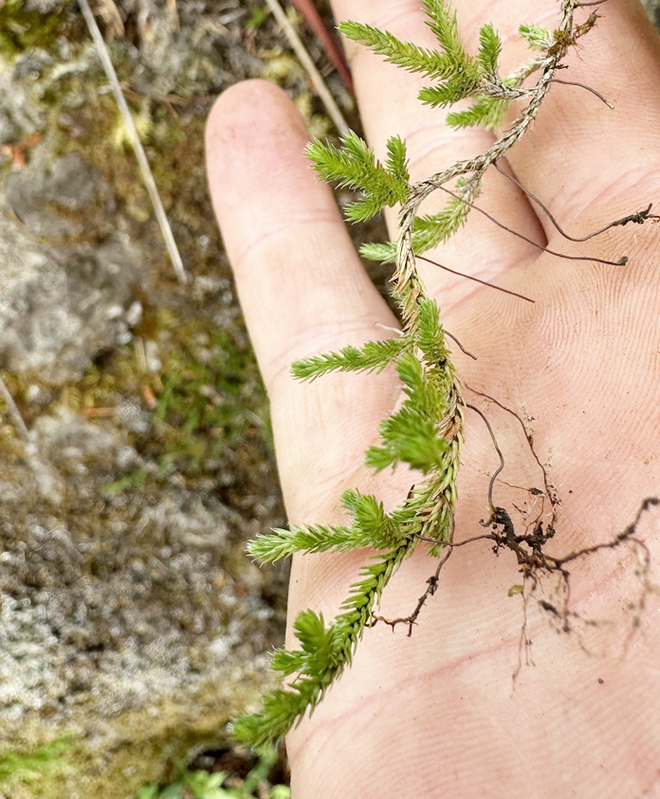
(3/)370 spp. in Huperzia (62, 7 in USA, 2 in Mexico, 1 in Brazil, none in Colombia), Phlegmariurus (307, worldwide pantropical. 75 in Colombia, 39 in Brazil, 17 in Mexico and 1 in USA), and Phylloglossum (1, Australia and New Zealand).
ISOETALES
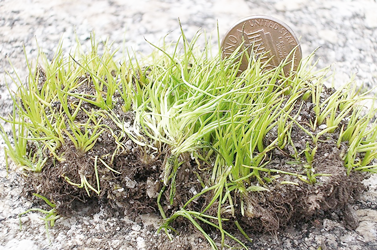
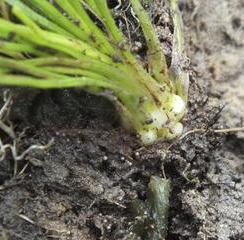
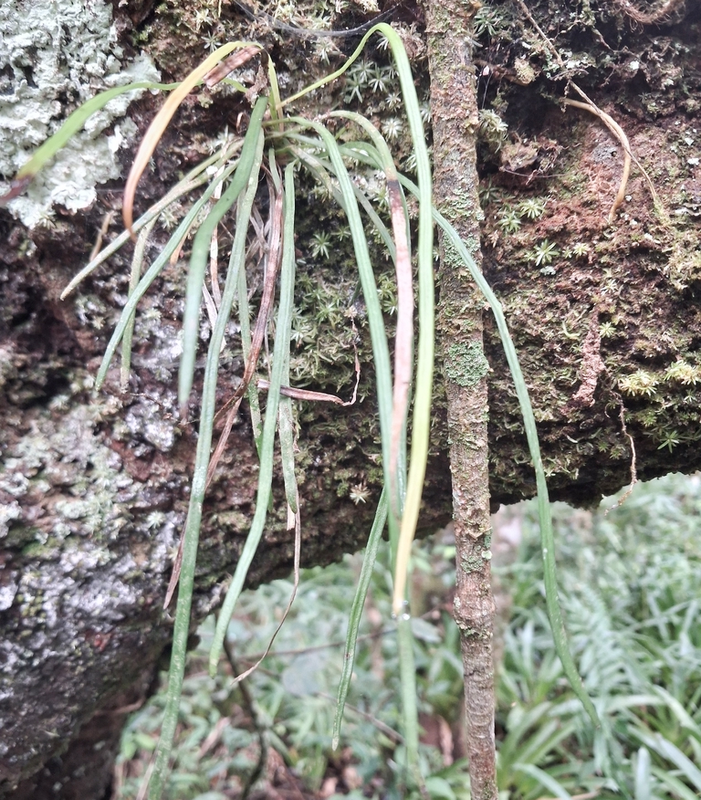
A single family in this order, Isoetaceae, and a single genus, Isoetes L., with 204 spp., subcosmopolitan. 37 in USA, 32 in Brazil (24ᴱ), 13 in Colombia and 9 in Mexico.
SELLAGINELALES
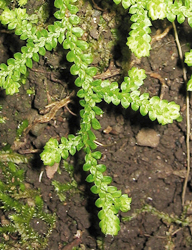
A single family, Selaginellaceae, with (19/)770 spp. and nine genera in New World. USA includes 7 genera (one endemic; Lepidoselaginella, Valdespinoa and Selaginoides unrecorded in Brazil), and Brazil includes only five (Gymnogynum, Bryodesma, Megaloselaginella, Pulviniella and Selaginella). Largest diversities in New World by genera priority criteria are Mexico (7/80), USA (7/36), Colombia (6/97) and Brazil (5/81).
Colombia includes Didiclis (unrecorded in Brazil). Brazil and Colombia tied in Bryodesma, Megalosellaginella and Pulviniella. Colombia surpasses Brazil in Gymnogynum (24 ✕ 16) and Selaginella (67 ✕ 60).
Mexico includes unbrazilian Didiclis, Mexisellaginela and Lepidoselaginella. Mexico surpasses Brazil in Bryodesma (21 ✕ 2) and Pulviniella (2 ✕ 1), and Brazil suprasses Mexico in Selaginella and Gymnogynum. Brazil includes Megalosellaginella unrecorded in Mexico.
SELAGINOIDOIDEAE
A single genus, Selaginoides (2), with S. spinulosa from Artic to Nevada, Colorado, Maine, Mediterranean, Caucasus and S Russia, also in Japan, and S. deflexa endemic to Hawaii.
BOREOSELAGINELLOIDAE
A single genus, Boreoselaginella (6), from E Asia to Russia.
MEXISELAGINELLOIDEAE
A single genus and species, endemic to C Mexico (Phytotaxa, 2025).
GYMNOGYNOIDEAE (BR)
Six genera, namely Afroselaginella (4, endemic to Africa), Ericetorum (8, Africa, Madagascar and Australia), Megaloselaginella (3, two from Costa Rica to N Brazil, one in Equatorial Guinea and Gabon), Gymnogynum (48, mostly tropical America, 1 tropical Africa, 1 in Asia; Colombia-24, Brazil-16, Mexico-7), Lepidoselaginella (3, Mexico, one up to SW USA in north and Costa Rica in south) and Bryodesma (56, almost cosmopolitan, mostly in temperate areas, mainly in USA-27, Mexico-21, Colombia-2, Brazil-2).
SINOSELAGINELLOIDEAE
Three genera, all unknown in New World, namely Austroselaginella (4, endemic to Australia), Korallia (15, Madagascar and adjacent islands) and Sinoselaginella (5, China extending to the Arabic area and E Africa).
PULVINELLIOIDEAE (BR)
A single genus, Pulviniella (17), scattered almost cosmopolitan, several in China, with 3 in New World, namely P. convoluta from Mexico to Brazil, Paraguay and West Indies, P. gypsophila endemic to Mexico, and P. pilifera from SW USA to NW Mexico.
LYCOPODIOIDOIDEAE
Four genera worldwide, Hypopterygiopsis (170, Asia and Pacific islands and a few in Africa and Madagascar), Didiclis (70, Africa, Asia, and Australasia, only one in New World, D. hoffmannii, from Mexico to Ecuador), Lycopodioides (12, Eurasia) and Valdespinoa (1, endemic to NW USA).
SELAGINELLOIDEAE (BR)
Three genera, Chuselaginella (70, Africa, Asia, Australia and southern Pacific islands), Kungiselaginella (12, Asia) and Selaginella (231, New World, mostly tropical America, only very few tropical Africa; Colombia-67, Brazil-60, Mexico-45, USA-4).

Simplified maximum likelihood phylogeny of Selaginellaceae based on plastid rbcL and five nuclear markers (excludes Mexiselaginella)
■----------------------------------------------------------------------------------------------------■
All data below follows the World Ferns website. The 12 countries and regions with the highest diversity of Lycophytes + Monilophytes worldwide are China (1,973 | 644 endemics), Colombia (1,748 | 198 endemics), Ecuador (1,533 | 191 endemics), Brazil (1,421 | 508 endemics), New Guinea (1,350 | 572 endemics), Peru (1,292 | 139 endemics), Venezuela (1,262 | 138 endemics), Bolivia (1,196 | 141 endemics), Costa Rica (1,172 | 114 endemics), Borneo (1,083 | 247 endemics), Mexico (1,053 | 200 endemics), and India (1,052 | 66 endemics).
The highest numbers of endemic species are found in China (644), New Guinea (572), Brazil (508), Madagascar (386), Borneo (265), Philippines (247), Mexico (200), and Colombia (198).
■----------------------------------------------------------------------------------------------------■
POLYPODIOPSIDA
Monilophytes has 11 orders, 51 families and 374 genera worldwide. In New World occur 44 families (38 in Brazil) and 198 genera (147 in Brazil and 51 are unknown). Families absent in New World are 7, namely Matoniaceae, Dipteridaceae, Cryptocaulaceae, Cystodiaceae, Hypodematiaceae, Rhachidosoraceae and Davalliaceae.
New World families unknown in Brazil (with New World distribution) includes Thyrsopteridaceae (JF/CH), Cibotiaceae (MX → NIC), Loxsomataceae (CR CL → BL), Diplaziopsidaceae (USA CAN), Arthropteridaceae (JF/CH) and Onocleaceae (CAN → GUA). Except Thyrsopteridaceae and Onocleaceae, all families are nationally disjunctly distributed.
National endemics includes genera only in Mexico (Baja, Baja California region), Papua New Guinea (Rheopteris), China (Trichoneuron and Cleistoblechnum), Australia (Howeogrammitis, Lord Howe), Indonesia (Xyropteris, Borneo and Sumatra), USA (Sadleria, Adenophorus and Hoiokula, all in Hawaii), New Zealand (Loxsoma, Icarus), Colombia (Luisma, known from Risaralda), New Caledonia (Stromatopteris, Grammitastrum, Thalassogrammitis), Philippines (Podosorus, from Isabela), Chile (Thyrsopteris, Juan Fernandes), South Korea (Mankyua, Cheju island) and South Africa (Rhizoglossum, W & N Cape).
NEW WORLD GENERA ABSENT IN BRAZIL
Excluding Cyatheales and Polypodiales, 34 genera of Monilophytes occur in New World, 28 in Brazil and six unknown, namely Claytosmunda (CAN USA), Marattia (MX AMC), Crepidomanes (MX → BL VZ WI), Diplopterygium (MX → BL VZ WI), Botrychium (AR CH) and Microschizaea (AR CH).
Cyatheales includes 12 genera in New World, nine in Brazil and three unknown in country, namely Cibotium (MX AMC), Loxsomopsis (CR → BL) and Thyrsopteris (CH), and all nationally disjuncts.
Among Polypodiales, there are 152 genera in New World, 110 in Brazil and 42 unknown in country, namely Coryphopteris (OW CN USA), Oreopteris (OW CAN USA), Gymnocarpium (CN USA), Homalosurus (CN USA), Matteuccia (CN USA), Onoclea (CN USA), Woodsia (CN USA), Aspidotis (CN USA MX), Thelypteris (OW CN USA MX CB PR), Cryptogramma (OW CN USA AR CH), Deparia (USA), Phegopteris (OW USA), Pentagramma (USA MX), Leptogramma (OW USA MX AMC), Bommeria (USA MX AMC), Sphenomeris (USA MX AMC WI CL), Astrolepis (USA MX AMC WI CL VZ EC PR BL AR CH), Myriopteris (USA MX AMC WI CL VZ EC PR BL AR CH), Notholaena (USA MX AMC CL VZ EC PR BL AR CH), Maxonia (USA AMC WI CL EC) | Baja (MX), Onocleopsis (MX AMC), Llavea (MX AMC), Cheiloplecton (MX AMC), Loxogramme (MX AMC), Scoliosurus (MX AMC), Odontosoria (MX AMC WI CL), Ephemeropteris (MX AMC CL VZ EC), Mildella (OW MX AMC WI EC), Ascogrammitis (MX AMC WI GU VZ CL EC PR BL), Galactodenia (MX AMC WI VZ CL EC PR BL), Aleuritopteris (OW MX AMC CL EC PR BL), Gaga (MX AMC CL VZ EC PR AR), Lomaphlebia (CB JM), Atalopteris (WI), Polystichopsis (WI VZ), Luisma (CL), Adetogramma (EC PR BL AR), Platycerium (OW PR BL), Arthopteris (CH), Synammia (AR CH) and Notogrammitis (OW AR CH).
MEXICO/COLOMBIA ✕ BRAZIL
MEXICAN GENERA ABSENT IN BRAZIL
Among orders except Cyatheales and Polypodiales, unbrazilian mexican genera includes Marattia (MX AMC), Crepidomanes (MX → BL VZ WI) and Diplopterygium (MX → BL VZ WI).
Among Cyatheales, only Cibotium (MX AMC) occur in Mexico but no in Brazil.
Among Polypodiales, 22 genera occur in Mexico but non in Brazil, namely Aspidotis (CN USA MX), Thelypteris (OW CN USA MX CB PR), Pentagramma (USA MX), Leptogramma (OW USA MX AMC), Bommeria (USA MX AMC), Sphenomeris (USA MX AMC WI CL), Astrolepis (USA MX AMC WI CL VZ EC PR BL AR CH), Myriopteris (USA MX AMC WI CL VZ EC PR BL AR CH), Notholaena (USA MX AMC CL VZ EC PR BL AR CH), Baja (MX), Onocleopsis (MX AMC), Llavea (MX AMC), Cheiloplecton (MX AMC), Loxogramme (MX AMC), Scoliosurus (MX AMC), Odontosoria (MX AMC WI CL), Ephemeropteris (MX AMC CL VZ EC), Mildella (OW MX AMC WI EC), Ascogrammitis (MX AMC WI GU VZ CL EC PR BL), Galactodenia (MX AMC WI VZ CL EC PR BL), Aleuritopteris (OW MX AMC CL EC PR BL) and Gaga (MX AMC CL VZ EC PR AR).
COLOMBIAN GENERA ABSENT IN BRAZIL
Among all orders, except Cyatheales and Polypodiales, only two genera occur in Colombia but are absent from Brazil, namely Crepidomanes (MX → BL VZ WI) and Diplopterygium (MX → BL VZ WI).
Among Cyatheales, only Loxsomopsis (CR → BL) occurs in Colombia and not in Brazil.
Among Polypodiales, 12 genera occur in Colombia but non in Brazil, namely Sphenomeris (USA MX AMC WI CL), Astrolepis (USA MX AMC WI CL VZ EC PR BL AR CH), Myriopteris (USA MX AMC WI CL VZ EC PR BL AR CH), Notholaena (USA MX AMC CL VZ EC PR BL AR CH), Maxonia (USA AMC WI CL EC), Odontosoria (MX AMC WI CL), Ephemeropteris (MX AMC CL VZ EC), Ascogrammitis (MX AMC WI GU VZ CL EC PR BL), Galactodenia (MX AMC WI VZ CL EC PR BL), Aleuritopteris (OW MX AMC CL EC PR BL), Gaga (MX AMC CL VZ EC PR AR) and Luisma (CL).
COLOMBIAN ADVANTAGES AGAINST BRAZIL BY GENERA (NUMBER OF SPECIES MORE THAN BRAZIL)
In all orders except Cyatheales and Polypodiales the advantages are in Hymenophyllum (22), Danaea (16), Sticherus (15), Trichomanes (6), Didymoglossum (2), Equisetum (1), Sceptridium (1), Psilotum (1), Polyphlebium (1) and Lygodium (1), totaling 66 species.
Among Cyatheales, the advantages are in Cyathea (72), Alsophila (5), Dicksonia (2) and Sphaeropteris (2), totaling 81 spp.
Among Polypodiales, the advantages belong Elaphoglossum (84), Jamesonia (31), Diplazium (31), Amauropelta (18), Parablechnum (12), Dennstaedtia (11), Tectaria (10), Lellingeria (10), Melpomene (9), Pteris (8), Pityrogramma (8), Alansmia (8), Meniscium (7), Radiovittaria (7), Campyloneurum (7), Serpocaulon (7), Stigmatopteris (6), Polybotrya (5), Mycopteris (4), Niphidium (4), Polystichum (4), Terpsichore (4), Megalastrum (4), Hymenasplenium (3), Steiropteris (3), Bolbitis (3), Hypolepis (3), Lomariopsis (3), Lomaridium (2), Pecluma (2), Polytaenium (2), Pleopeltis (2), Austroblechnum (2), Lomariocycas (2), Enterosora (2), Pellaea (2), Athyrium (1), Didymochlaena (1), Hypoderris (1), Grammitis (1), Mickelia (1) and Dryopteris (1), totaling 336 spp.

PHYLOGENY OF MONILOPHYTES (TAXATECA)
TAXONOMY
All six basal orders are each represented by a single family.
EQUISSETALES
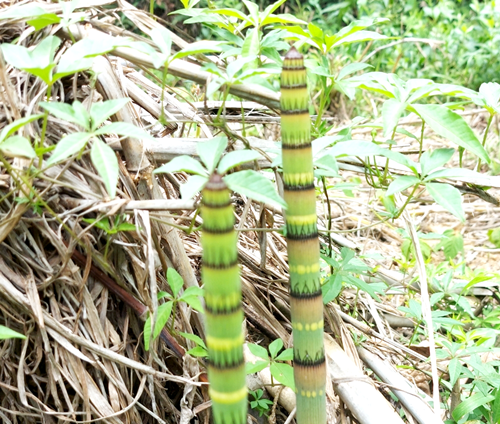
Only a single family, Equisetaceae, and a single genus, Equisetum L. (17, 26 hybrids). 4 spp. in Mexico (all in subg Hypochaete), 3 in Colombia (in subg Hypochaete and subg Paramochaete, the most basal) and only two in Brazil (E. bogotense and E. giganteum, in two subgenera).
Equisetum myriochaetum, also known as Mexican giant horsetail, is a species of horsetail that is native Mexico to Costa Rica, Venezuela, Colombia, Ecuador and Peru. It is the largest horsetail species, commonly reaching 4.6 m, with the largest recorded specimen having a height of 7.3 m (Wikipedia).
OPHIOLOSSALES
Only a single family worldwide, Ophioglossaceae, with 11 genera, being six urecorded in New World, namely Mankyua (1, Korea), Rhizoglossum (1, South Africa), Ophioderma (6, Africa to Japan, up to Pacific Islands), Helminthostachys (1, Asia to Australia), Japanobotrychum (2, Africa, Asia) and Sahashia (1, Asia). Zhang & Zhang (Molecular Phylogenetics and Evolution, 2022) broken Ophioglossum in four genera, three news, Goswamia, Haukia and Whittieria.
Mexico has (5/)13 spp., Colombia (4/)7 and Brazil only (4/)6.
OPHIOGLOSSOIDEAE
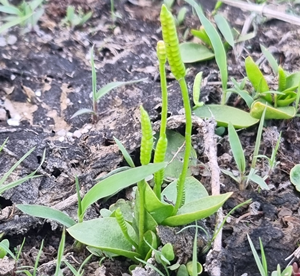
Cheiroglossa ‣ two spp., one from Madagascar to Mauritius, one widely in New World from USA to Argentina and West Indies.
Ophioglossum ‣ 51 spp., almost worldwide. 7 spp. in Mexico; Brazil and Colombia 3 each.
BOTRYCHIOIDEAE
Botrychium ‣ 36 spp., Holarctic, two spp. to Mexico, one disjunct in Argentina and Chile.
Botrypus ‣ only one sp, widely distributed worldwide, in New World from Alaska to Uruguay and West Indies.
Sceptridium ‣ 23 spp., worldwide. Mexico and Colombia two spp. each, only one in Brazil.
PSILOTALES
Only a single family, Psilotaceae, with two genera, namely Tmesipteris (16, Central & E Malesia to S Pacific) and Psilotum, with two spp., both in New World: P. nudum from North America, Mexico, America Central, West Indies, Trinidad & Tobago, Venezuela, Guianas, Colombia, Ecuador, Peru, Bolivia, Brazil and Cono Sur; and P. flaccidum from Seychelles to Hawaii, Mexico, America Central, West Indies, Colombia and Peru.
MARATTIALES
(6/)180 spp. in a single family, Marattiaceae. Six genera, three unrecorded in New World, namely Angiopteris (53, W Indian Ocean, tropical & subtropical Asia to Pacific), Christensenia (1, SC China to tropical Asia) and Ptisana (37, tropical & subtropical Old World to Pacific). 33 spp. in Colombia, 18 in Brazil and 7 in Mexico.
Danaea ‣ 79 spp., Mexico to S Brazil. Mexico has 4 spp. (none endemics), Colombia has 32 (10 endemics) and Brazil has 16 (5 endemics).
Eupodium ‣ 4 spp., one from Panama to Argentina (unrecorded in Brazil), one in West Indies, and two endemic to Brazil (holoendemic).
Marattia ‣ 6 spp., one in Hawai, 4 from Mexico (3) to Panama (all 4), and one in West Indies (Cuba, Hispaniola and Jamaica).
OSMUNDALES
(6/)23 spp. in a single family, Osmudaceae, with six genera, three unrecorded in New World, namely Leptopteris (6, Maluku to SW Pacific), Plenasium (4, Asia) and Todea (2, Africa, New Guinea to Australasia).
Claytosmunda ‣ a single sp, from Canada, USA and Asia.
Osmunda ‣ 9 spp., 7 in Old World, O. spectabilis from Canada to Uruguay and West Indies, and O. bradei endemic to dry savanas in C Brazil.
Osmundastrum ‣ only one sp, O. cinnamomeum, from temperate Asia to Indo-China and Canada to Argentina and West Indies.
HYMENOPHYLLALES
(9/)557 spp. in a single family, Hymenophyllaceae, with two genera unrecorded in New World, Cephalomanes (5, Old World) and Callistopteris (5, Old World, Hawaii). 131 spp. in Colombia, 99 in Brazil and 47 in Mexico.
Abrodictyum ‣ 31 spp., tropics, mostly Old World, only few New World. Brazil and Colombia two species each, Mexico only one.
Crepidomanes ‣ 44 spp., paleotropical and Pacific, only one New World, C. pyxidiferum , from Mexico to Venezuela, also in Bolivia and West Indies.
Didymoglossum ‣ 52 spp., pantropical. 15 spp. in Colombia, 13 in Brazil and 11 in Mexico.
Hymenophyllum ‣ 303 spp., pantropical, mostly neotropical. 62 spp. in Colombia, 40 in Brazil and 22 in Mexico.
Polyphlebium ‣ 16 spp., southern temperate and mountain forests of low altitudes. 5 spp. in Colombia, 4 in Brazil and two in Mexico.
Trichomanes ‣ 75 spp., mostly neotropics, but 5 in tropical Africa, Madagascar and Indian Ocean, one in Malesia. Colombia has 43 spp., Brazil 37 and Mexico only 8.
Vandenboschia ‣ 26 spp., pantropical. Brazil and Colombia 3 spp. each, Mexico has two.
GLEICHENIALES
Three families and nine genera, two families unrecorded in New World.
GLECIHENIACEAE
(7/)156 spp. Three genera do not occur in New World, namely Gleichenia (15, Rwanda to S Africa, W Indian Ocean, Amsterdam Island, Indo-China to SW Pacific), Rouxopteris (1, Madagascar and Reunion) and Stromatopteris (1, New Caledonia). 33 spp. in Colombia, 20 in Brazil and 7 in Mexico.
Dicranopteris ‣ 27 spp., tropics and subtropics, 5 in Brazil (two endemics), two in Colombia and one in Mexico.
Diplopterygium ‣ 21 spp., tropical & subtropical Asia to Pacific, one in New World, D. bancroftii, from Mexico to Venezuela and Bolivia, West Indies, unknown in Brazil.
Gleichenella ‣ only one sp, G. pectinata, from Mexico to Guianas, Uruguay and West Indies, unknown in Argentina and Chile.
Sticherus ‣ 90 spp., Tanzania to S Africa, W Indian Ocean, tropical & subtropical Asia to Pacific, 55 in New World, from Mexico to southen South America and West Indies. 29 spp. in Colombia, 14 in Brazil and 4 in Mexico.
DIPTERIDACEAE
Two genera, unrecorded in New World, Cheiropleuria (3, S China and temperate E Asia to Indo-China and New Guinea) and Dipteris (8, Tibet to Taiwan and NE Australia, also Pacific Islands).
MATONIACEAE
Two genera, unrecorded in New World, Matonia (2, Thailand to New Guinea) and Phanerosorus (2, Borneo, Maluku and New Guinea).
SCHIZAEALES
Three families and 5 genera. 81 spp. in Brazil, 28 in Colombia and 27 in Mexico.
SCHIZAEACEAE
(3/)39 spp. worldwide, in three genera, all in New World.
Actinostachys ‣ 17 spp., tropical & subtropical America, W Indian Ocean to W Pacific. Three spp. in New World, two in Brazil and Colombia, one in Mexico.
Microschizaea ‣ 7 spp., six from Malesia, Australia, New Zealand and Pacific (one up to southern Argentina and Chile), and one in Zimbabue and South Africa.
Schizaea ‣ 15 spp., E Canada to tropical & S South America, Santa Helena, Tanzania to S Africa, W Indian Ocean, tropical & subtropical Asia to Pacific. 7 spp. in Brazil, 6 in Colombia and two in Mexico.
LYGODIACEAE
A single genus, Lygodium (29), subcosmopolitan. 7 spp. in New World, Colombia and Mexico three each, Brazil only two.
ANEMIACEAE
A single genus Anemia (118), from New World, Africa, Madagascar and India. 69 spp. in Brazil, 21 in Mexico and 17 in Colombia.
SALVINIALES
Two families and 5 genera, all occurring in Brazil.
MARSILEACEAE
Three genera. 8 spp. in Mexico, Brazil and Colombia six each.
Marsilea ‣ 49 spp., cosmopolitan, 11 in New World. 7 spp. in Mexico, 4 in Colombia and Brazil each.
Pilularia ‣ 7 spp., two endemics to South Africa, one endemic to Ethiopia, one in Australia and New Zealand, two from Europe to C Asia, and P. americana USA to NW Mexico, Colombia to Venezuela, Bolivia to S Brazil and S South America.
Regnellidium ‣ only one sp, R. diphyllum, S Brazil to NE Argentina and Uruguay.
SALVINIACEAE
(2/)17 spp. worldwide. 10 spp. in Brazil, six in Colombia and 4 in Mexico.
Azolla ‣ 6 spp., tropical & subtropical Old World, Canada to Tristan da Cunha, 5 in New World, three in Brazil and Colombia each, two in Mexico.
Salvinia ‣ 11 spp., Mexico to Cono Sur, Africa, Eurasia, 10 in New World. 7 spp. in Brazil, 3 in Colombia and two in Mexico.
CYATHEALES
Eight families, (13/)785 spp. worldwide. Both Polypodiales and Cyatheales differ from other ferns in having a photoreceptor called a neochrome, which allows them to perform photosynthesis better in low-light conditions, such as in the shadows on the forest floor. The common ancestor of the two groups appears to have derived the neochrome via horizontal gene transfer from a hornwort.
THYRSOPTRIDACEAE
A single genus, Thyrsopteris, with only one sp, T. elegans Kunze, endemic to Juan Fernández island in Chile.
LOXSOMATACEAE
Two genera, Loxsoma (1, New Zealand) and Loxsomopsis, monotypic with L. pearcei, known from Costa Rica and Colombia to Bolivia.
CULCITACEAE
A single genus, Culcita (2), with C. coniifolia from S Mexico to Bolivia and SE Brazil, and C. macrocarpa from Macaronesia, N Portugal to NW & S Spain.
PLAGIOGYRIACEAE
A single genus, Plagiogyria (12), with 11 spp. from Kuril islands to tropical Asia, and one in Mexico to Brazil and West Indies.
CIBOTIACEAE
A single genus, Cibotium (11), with nine spp. in E Asia and two from Mexico (1 endemic) to Nicaragua.
METAXYACEAE
A single genus, Metaxya (6) from Belize to C Brazil. Colombia and Brazil 4 spp. each.
DICKSONIACEAE
(3/)39 spp. Calochlaena (5, Malesia to SW Pacific) does not occur in New World.
Dicksonia (32) ‣ Malesia to SW Pacific, Mexico to S tropical America, Santa Helena. 8 spp. in New World, 3 in Colombia, Brazil and Mexico one each.
Lophosoria ‣ two spp., L. quadripinnata from West Indies, Mexico to Bolivia, also in SE Brazil and Cono Sur, and L. quesadae endemic to Costa Rica.
CYATHEACEAE
(4/)714 spp. worldwide. All genera occur in South America.
Alsophila ‣ 249 spp., 44 in New World, 8 in Colombia, 3 in Brazil, two in Mexico.
Cyathea ‣ 315 spp., Mexico to tropical America, New Guinea to southern Pacific, approximately 290 in New World, 126 in Colombia, 54 in Brazil and 11 in Mexico.
Gymnosphaera ‣ 46 spp., mainly Old World, except by G. capensis from SE & S Brazil, Tanzania to southern Africa, and G. salvinii from Mexico (Veracruz, Oaxaca, Chiapas) to Nicaragua, disjunct in SE Brazil (Minas Gerais).
Sphaeropteris ‣ 104 spp. from Mexico to Venezuela and Bolivia, West Indies, Nepal to S China and southern Pacific. Six spp. in New World, 3 in Colombia, Mexico and Brazil one each.
POLYPODIALES
26 families, all native to New World except Cryptocaulaceae (1/1, Indochina), Cystodiaceae (1/1, Indonesia and Papua New Guinea), Davalliaceae (2/65, mostly tropical and subtropical Asia, some Pacific and Australia, few in Canary islands, and tropical Africa), Hypodematiaceae (2/19, Africa to Malesia and Pacific) and Rachidosoraceae (1/8, Asia).
Polypodiales represents an extraordinary radiation worldwide, comprising 29 families and a total of 9,659 species, namely Dryopteridaceae (2,207), Polypodiaceae (1,775), Pteridaceae (1,405), Thelypteridaceae (1,181), Aspleniaceae (875), Athyriaceae (747), Tectariaceae (301), Blechnaceae (278), Lindsaeaceae (255), Dennstaedtiaceae (242), Davalliaceae (65), Lomariopsidaceae (61), Woodsiaceae (48), Cystopteridaceae (35), Oleandraceae (30), Nephrolepidaceae (29), Pteridryaceae (26), Didymochlaenaceae (22), Saccolomataceae (21), Hypodematiaceae (19), Arthropteridaceae (13), Rachidosoraceae (8), Onocleaceae (5), Diplasiopsidaceae (4), Desmophlebiaceae (2), Lonchthidaceae (2), Cryptocaulaceae (1), Hemidictyaceae (1) and Cystodiaceae (1). The nine largest families alone account for 9,024 species.
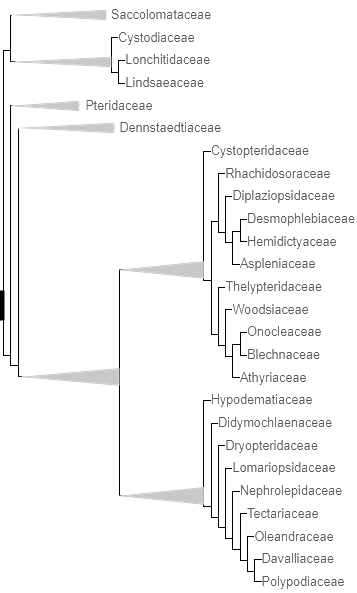
PHYLOGENY OF POLYPODIALES (EXCLUDES RECENT RECOGNIZED FAMILIES)
Polypodiales are unique in bearing sporangia with a vertical annulus interrupted by the stalk and stomium. Both Polypodiales and Cyatheales differ from other ferns in having a photoreceptor called a neochrome, which allows them to perform photosynthesis better in low-light conditions, such as in the shadows on the forest floor. The common ancestor of the two groups appears to have derived the neochrome via horizontal gene transfer from a hornwort.
SACCOLOMATACEAE
(2/)21 spp. worldwide, with Orthiopteris tropical Asia and W-Pacific-8, Madagascar-1) and Saccoloma (17, tropical America. 9 spp. in Brazil, 5 in Colombia, two in Mexico).
DESMOPHLEBIACEAE
Two species in Desmophlebium, D. lechleri from Costa Rica to Brazil, and D. longisorum from Colombia to Peru.
HEMIDICTYACEAE
A single species, Hemidictyum marginatum, from Mexico to C Brazil and West Indies.
LIDSAEACEAE
(7/)255 spp. worldwide. For genera do not occur in New World, namely Nesolindsaea (2, Seychelles, Sri Lanka to Malesia), Osmolindsaea (7, S tropical Africa, Madagascar, tropical & subtropical Asia), Tapeinidium (19, Indo-China to Nansei-shoto and Pacific) and Xyropteris (1, endemic to Indonesia in Borneo and Sumatra). 37 spp. in Brazil, 31 in Colombia and 11 in Mexico.
Lindsaea ‣ 188 spp., cosmopolitan, 65 in New World. 37 spp. in Brazil, 26 in Colombia and only 8 in Mexico.
Odontosoria ‣ 35 spp., 22 in Uganda to tropical Africa, W Indian Ocean, tropical & subtropical Asia, Hawai, 13 in New World, from Mexico (2) to Colombia (3) and West Indies.
Sphenomeris ‣ 3 spp., one in S Florida to West Indies, Mexico (Chiapas), and two endemics to Colombia.
LONCHITIDACEAE
A single genus, Lonchitis, with two spp., L. hirsuta from Mexico to SE Brazil, and L. occidentalis Baker in tropical Africa and Madagascar.
PTERIDACEAE
61 genera and 1,405 spp. Genera unknown in New World includes Actiniopteris (5, Africa, Arabian Peninsula, Iran to Myanmar), Antrophyopsis (4, Africa, Indian Ocean), Antrophyum (39, tropical & subtropical Old World to Pacific), Austrogramme (6, Philippines to New Caledonia), Calciphilopteris (4, tropical Asia to S China and N Australia), Cerosora (4, S DR Congo to S Africa, W Indian Ocean, Himalaya to S China and W Malesia), Coniogramme (22, tropical Africa, E Russia to New Guinea and Pakistan), Cosentinia (1, Macaronesia, Mediterranean to W Himalaya and NE tropical Africa), Haplopteris (41, tropical & subtropical Old World to Pacific), Mickelopteris (1, Asia), Oeosporangium (28, Old World), Onychium (11, NE tropical Africa, tropical & subtropical Asia to N Australia), Paragymnopteris (6, Old World), Rheopteris (1, Papua New Guinea), Syngramma (16, Indo-China to W Pacific), Taenitis (16, Hainan to tropical Asia and W Pacific) and Vaginularia (6, Taiwan and Sumatra to Queensland).
Acrostichum ‣ 3 spp., two in New World, both very widely distributed from Florida to Bolivia and Argentona, Brazil and West Indies.
Adiantopsis ‣ 33 spp., all from New World. 13 spp. in Brazil, 4 in Colombia and two in Mexico.
Adiantum ‣ cosmopolitan, 242 spp., 151 in New World. 66 spp. in Brazil, 42 in Colombia and 36 in Mexico.
Aleuritopteris ‣ 43 spp., mostly China, India, Indochina, three in Africa, two in Neotropics, from Mexico (2) and Bolivia, one in Colombia, unknown in Brazil.
Ananthacorus ‣ only one sp., A. angustifolius, from Mexico to SE Brazil and West Indies.
Anogramma ‣ 3 spp., one from Brazil and adjacent Cono Sur, one in Indian region, another subcosmopolitan (including Brazil, Mexico and Colombia).
Argyrochosma ‣ 19 spp., New World, China. 12 spp. in Mexico, 3 in Brazil, one in Colombia.
Aspidotis ‣ 4 spp., Canada to Mexico (2).
Astrolepis ‣ 8 spp., New World. All in Mexico, one in Colombia, unknown in Brazil.
Baja ‣ a single species, endemic to Baja California region in NW Mexico.
Bommeria ‣ 5 spp., USA to Nicaragua.
Ceratopteris ‣ 8 spp., 3 in New World, all widely in Old and New World. Brazil, Colombia and Mexico two each.
Cheilanthes (Cheilanthes s.s. + C. bolborrhiza, excludes micropteis group, excludes spinoff 26 spp.). 89 spp., North and tropical America, some tropical Africa, Australia. Nine spp. in Brazil, 5 in Mexico, two in Colombia.
Cheiloplecton ‣ a single species, Mexico to Honduras.
Cryptogramma ‣ nine spp., subarctic & temperate northern Hemisphere, 4 in North America, one in southern Argentina and Chile.
Doryopteris (Doryopteris Old World + Doryopteris New World block 1 + Doryopteris block 2) ‣ 38 spp., tropical America, S India, Malesia, Africa, Madagascar, Australia, southern Pacific. Block 1 (5) occur from Africa and Madagascar. Block 2 (4) occur Guyana region from Venezuela to Suriname and N Brazil (2), and two endemics to SE & S Brazil. Block 3 (27) is widely distributed in over range of genus, 17 in Brazil, 3 in Colombia and two in Mexico.
Gaga ‣ 19 spp., SW USA, Mexico and America Central to Argentina. 17 spp. in Mexico, 4 in Colombia, unknown in Brazil.
Gastoniella ‣ 3 spp., one in Ascension, one endemic to Mexico, and G. chaerophylla from Mexico to Argentina and Brazil, also in West Indies, unknown in Colombia.
Hecistopteris ‣ 3 spp., SW Mexico (1) to S Brazil (2); also in Colombia (1).
Hemionitis ‣ 6 spp., tropical America. Brazil and Mexico 4 spp. each, two in Colombia.
Jamesonia ‣ 61 spp., tropical Andes (usually on high mountains), locally Mexico, Costa Rica, SE Brazil, one in Tristan da Cunha. 40 spp. in Colombia, nine in Brazil and 5 in Mexico.
Llavea ‣ only one sp. from Mexico, Guatemala and Costa Rica.
Lytoneuron ‣ 17 spp., South America. All species from Brazil, one up to northern South America excluding Colombia, and two up to W & SW South America up to Ecuador in northern.
Mildella ‣ 4 spp., Mexico (2), America Central, West Indies and Ecuador, and subtropical Asia.
Mineirella ‣ 5 spp., South America. 4 spp. in Brazil, only one in Colombia.
Myriopteris ‣ 43 spp., North America to Chile and West Indies, mostly Mexico, one in southern Africa. 34 spp. in Mexico, six in Colombia, unknown in Brazil.
Notholaena ‣ 33 spp., New World. 28 spp. in Mexico, one in Colombia, unknown in Brazil.
Ormopteris ‣ 5 spp. from Brazil, one up to Venezuela and Bolivia.
Pellaea ‣ 50 spp., SW USA, Mexico, to Galapagos and Haiti, South Africa, few east to India, China and New Zealand, N Spain. 15 spp. in Mexico, 4 in Colombia, two in Brazil.
Pentagramma ‣ 5 spp., USA to NW Mexico.
Pityrogramma ‣ 25 spp., tropical & subtropical America, E Central & E tropical Africa to Malawi, Madagascar. 12 spp. in Colombia, Brazil and Mexico 4 each.
Polytaenium ‣ 13 spp., Mexico to Argentina and West Indies. 7 spp. in Colombia, Brazil and Mexico 5 each.
Pteris ‣ 341 spp., cosmopolitan, 77 in New World. 28 spp. in Colombia, 20 in Brazil and 18 in Mexico.
Pterozonium ‣ 14 spp., Costa Rica to Peru and N Brazil, mainly in venezuelan tepuis. 3 spp. in Brazil, two in Colombia.
Radiovittaria ‣ 10 spp., SE Mexico to S Brazil and West Indies. Nine spp. in Colombia, two in Brazil, one in Mexico.
Scoliosorus ‣ only one sp., from Mexico to Panama.
Trachyteris ‣ 4 spp., two from Ecuador to Argentina and Paraguay, one in Brazil, another in Madagascar.
Tryonia ‣ 5 spp., one endemic to Colombia and 4 in Brazil, one up to Uruguay.
Vittaria ‣ 7 spp., New World and Africa. Brazil and Mexico three spp. each, two in Colombia.
DENNSTAEDTIACEAE
11 genera and 242 spp., all in New World except Monachosorum (4, C Himalaya and Yunnan to Honshu, Taiwan to Philippines and Borneo, New Guinea).
Blotiella ‣ 21 spp., B. lindeniana from Costa Rica to Venezuela and Bolivia, SE & S Brazil, West Indies, remaining 20 in tropical & S Africa to W Indian Ocean.
Dennstaedtia ‣ 55 spp., mostly tropical, 24 in New World. 15 spp. in Colombia, six in Mexico and 4 in Brazil.
Histiopteris ‣ 12 spp. from tropics of Old World, with H. incisa also in tropical America from Mexico to Bolivia and West Indies.
Hiya ‣ 4 spp., Malesia (2), SW Pacific (1) and tropical America (H. nigrescens, from Mexico to Brazil and West Indies).
Hypolepis ‣ 69 spp., tropics & subtropics to Tristan da Cunha, 52 in New World. 14 spp. in Colombia, 12 in Brazil and nine in Mexico.
Microlepia ‣ 51 spp., tropical & subtropical Old World to Pacific, with M. speluncae collected also in Cuba, Jamaica, Franch Guiana, Ecuador, Brazil, Bolivia, Paraguay and Argentina.
Mucura ‣ two spp. in New World, both simultaneously in Mexico, Colombia and Brazil.
Paesia ‣ 12 spp., nine from Taiwan, Malesia to S Pacific and 3 from Costa Rica to SE Brazil, Cuba, Jamaica. Brazil and Colombia one each, unknown in Mexico.
Pteridium ‣ 4 spp., cosmopolitan, three very widespread (all in Mexico; Brazil and Colombia two each), one from India to Australia.
CYSTOPTERIDACEAE
Three genera, Acystopteris (3, Himalaya to Japan and Malesia) do not occur in New World.
Cystopteris ‣ 23 spp., worldwide, mountains in tropics. 15 spp. in New World, 4 in Mexico, two in Brazil, unknown in Colombia.
Gymnocarpium ‣ 9 spp., north temperate to New Guinea, fully unknown in America Latina.
DIPLASIOPSIDACEAE
Two genera, Diplaziopsis (3, Asia) and Homalosorus, with a single species, from USA and Canada.
PTERIDRYACEAE
(4/)26 spp. worldwide, three genera unknown in New World, namely Malaifilix (1, Malesia region), Polydictyum (4, Asia to Pacific) and Pteridrys (22, India to New Guinea).
Draconopteris ‣ two spp., one in Malesia region, another in Nicaragua to Bolivia and N Brazil.
ARTHROPTERIDACEAE
A single genus, Arthropteris (13), paleotropical to south-temperate, mostly tropical Africa and Madagascar, two in Malesia, four in Australia, not in mainland New World, but one in Juan Fernandez islands, Chile.
ASPLENIACEAE
Two genera and 835 spp., both in New World.
Asplenium ‣ 768 spp., 257 in New World. 84 spp. in Mexico, 74 in Brazil and 73 in Colombia.
Hymenasplenium ‣ 67 spp., 57 in Old World tropics and 10 in New World. 9 spp. in Colombia, six in Brazil and 4 in Mexico.
THELYPTERIDACEAE
42 genera and 1,181 spp. Genera unknown in New World includes Abacopteris (14, continental SE Asia, Malesia, Australia, Africa), Amblovenatum (7, Africa and Asia), Ampelopteris (1, Asia, Africa), Chingia (25, SE Asia to Australia), Cyclogramma (9, N India to S China, Taiwan, Philippines), Glaphyropteridopsis (11, E Asia), Grypothrix (14, Indochina, Malesia to S China and Australia), Hoiokula (2, Hawaii), Macrothelypteris (9, tropical and subtropical Asia, Malesia, Queensland, Pacific, Africa), Menisciopsis (7, Himalaya, Malesia, Pacific, Hawaii), Menisorus (5, Africa), Mesophlebion (17, SE Asia), Mesopteris (6, E Asia), Metathelypteris (17, E Asia south to Malesia, Solomon island, Sri Lanka, Africa, Fernando Póo, São Tomé, South Africa), Pakau (1, Australia, New Zealand), Plesioneuron (60, Malesia, Pacific islands to Tahiti), Pneumatopteris (31, Asia to Pacific), Pronephrium (40, tropical Asia, few Madagascar, Australia, Pacific), Pseudocyclosorus (13, tropical Africa, India and Himalaya, China, SE Asia, Philippines), Pseudophegopteris (24, tropical Africa, Indian Ocean, S China and Himalaya, through Malesia to Fiji and Hawaii), Reholttumia (29, SE Asia, some Pacific, Australasia), Sphaerostephanos (192, Africa, Asia, Pacific Islands), Stegnogramma (7, Asia), Strophocaulon (2, Indian Ocean, Malesia, N Australia, Oceania) and Trigonospora (7, tropical Asia).
Amauropelta ‣ 239 spp., Neotropics, few Nearctic, Pacific, tropical Africa and Indian Ocean. 49 spp. in Colombia, 31 in Brazil and 25 in Mexico.
Christella ‣ 71 spp., mostly restricted to the Old World tropics and subtropics, from Africa through India and SE Asia, China, Japan, and Malesia, Melanesia, and Polynesia, three in New World, all of these in Brazil and Colombia, and two in Mexico.
Coryphopteris ‣ 70, mostly Malesia, to Melanesia and Polynesia, southern Himalayas, some to S Russia, one single species in North America.
Cyclosorus ‣ three spp., two in Africa, one pantropical, including Brazil, Mexico and Colombia.
Goniopteris ‣ 135 spp., Neotropics. 40 spp. in Brazil, 25 in Mexico and 21 in Colombia.
Leptogramma ‣ 29 spp., mostly Himalayas (S China) to Japan and Malesia, one in South Africa, one in Europe, two in New World, one in SE USA, another from Mexico to Panama.
Meniscium ‣ 25 spp., Neotropics. 19 spp. in Colombia, 12 in Brazil and 5 in Mexico.
Oreopteris ‣ 3 spp., Asia, Europe, one in Canada and USA.
Pelazoneuron ‣ 19 spp., New World. 12 spp. in Mexico, 5 in Colombia and 3 in Brazil.
Phegopteris ‣ 6 spp., northern temperate Asia, Europe and North America. Unknown in Mexico.
Steiropteris ‣ 28 spp., Neotropics. 12 spp. in Colombia, nine in Brazil and only one in Mexico.
Thelypteris ‣ two spp., one in Africa, Madagascar, Sri Lanka and China to Australia, New Zealand and Argentina, another in Eurasia, Canada, USA, Mexico, Cuba and Peru.
WOODSIACEAE
Two genera, both in New World.
Physematium ‣ 20 spp., North America (subg Woodsiopsis), New World and southern Africa and Madagascar (subg Physematium), C Asia to E Asia (subg Cheilanthopsis). 8 spp. in Mexico, Brazil and Colombia one each.
Woodsia ‣ 28 spp., north temperate holarctic, few China and Taiwan (subg Eriosorus). Three spp. in USA, absent in Mexico, Brazil and Colombia.
ONOCLEACEAE
Four genera, with Pentarhizidium (1, China, Nepal, India) unknown in New World.
Matteuccia ‣ two spp., one in Eurasia, another from Alaska to USA.
Onocleopsis ‣ a single species from Mexico to Guatemala.
Onoclea ‣ a single species from E Asia, Canada and USA.
BLECHNACEAE
26 genera and 278 spp. New World outsiders includes Blechnidium (1, China and Taiwan to NE India), Blechnopsis (2, Asia to Pacific), Brainea (1, tropical Asia), Diploblechnum (6, Malesia, Australia, Pacific), Doodia (19, Australia, New Zealand, Pacific to Hawaii), Cleistoblechnum (1, China), Icarus (1, New Zealand), Oceaniopteris (8, Malesia, W Pacific, Australia), Sadleria (6, Hawaii), Spicantopsis (3, Asia) and Stenochlaena (6, India to NE Australia, east to W Pacific, tropical Africa).
Anchistea ‣ only one sp., from Canada, USA and Cuba.
Austroblechnum ‣ 34 spp., tropical to south-tropical, many in temperate South America, Pacific and New Zealand, few in tropical America (north to Mexico and West Indies), Madagascar and Malesia. Nine spp. in Colombia, 7 in Brazil and 5 in Mexico.
Blechnum ‣ 23 spp., mostly neotropical, few in southern Africa. 12 spp. in Brazil, 7 in Colombia and 5 in Mexico.
Cranfillia ‣ 23 spp., Malesia (4), many Pacific and Neotropics (4). Two spp. in Brazil, one in Colombia, unknown in Mexico.
Lomaria ‣ 7 spp., highly disjunct, Brazil, Ecuador, New Caledonia, Australia and New Zealand one endemic each, one in Peru to Bolivia, another in southern Africa.
Lomaridium ‣ 16 spp., Neotropics, tropical E Africa, Madagascar and one in Australasia. 4 spp. in Colombia; Brazil and Mexico two each.
Lomariocycas ‣ 17 spp., Neotropics, Africa and Madagascar. 4 spp. in Colombia, two in Brazil, unknown in Mexico.
Lorinseria ‣ only one sp. from Canada and USA.
Neoblechnum ‣ a single species from Mexico to Guatemala, and widely in tropical South America.
Parablechnum ‣ 71 spp., pantropical. 18 spp. in Colombia, six in Brazil and 3 in Mexico.
Salpichlaena ‣ 4 spp., Central to South America, all in Brazil, three in Colombia, unknown in Mexico.
Struthiopteris ‣ 3 spp., holartic to E Asia, one in Canada and USA.
Telmatoblechnum ‣ two spp., one from tropical Asia and Australia, another in New World, from Florida to Uruguay and West Indies.
Woodwardia ‣ 13 spp., widespread in northern hemisphere, south to Costa Rica, W Indonesia, mainly E Asia, also in New World. 4 spp. in Mexico, unknown in Brazil and Colombia.
ATHRYACEAE
Nine genera and 747 spp., three unknown in New World, namely Anisocampium (4, E Asia, S Himalaya and Indochina, one to Sri Lanka and Malesia), Cornopteris (13, China, E Asia, tropical Asia) and Pseudathyrium (1, Europa, W Asia).
Athyrium ‣ 174 spp., worldwide, mostly northern hemisphere, many in China (over 100), several in tropical Africa and Madagascar, few in the New World (19). Three spp. in Mexico, two in Colombia, one in Brazil.
Deparia ‣ 78 spp., mostly China, some tropical Asia, Pacific, few Madagascar, three in USA.
Diplazium ‣ 480 spp., cosmopolitan, 100 in tropical America. 54 spp. in Colombia, 27 in Mexico and 23 in Brazil.
Ephemeropteris ‣ three spp., Mexico (all) to Venezuela and Ecuador. Only one in South America.
DIDYMOCHLAENACEAE
A single genus, Didymochlaena (22), six spp. in New World. Three spp. in Colombia, two in Brazil and one in Mexico.
DRYOPTERIDACEAE
27 genera worldwide and 2,207 spp., 7 of these unknown in New World, namely Arthrobotrya (3, Australia and New Zealand), Cyrtomium (39, Asia and Africa), Lastreopsis (21, Asia to Pacific), Lomagramma (18, Asia to Pacific), Pleocnemia (20, NE India, SE China, Taiwan through Malesia to Samoa), Teratophyllum (10, tropical Asia) and Trichoneuron (1, China).
Arachniodes ‣ 71 spp., tropics and subtropics to Russian Far East. Two spp. in Colombia, Mexico and Brazil one each.
Atalopteris ‣ 3 spp., Cuba, Hispaniola and Jamaica.
Bolbitis ‣ 67 spp., tropics and subtropics, 11 in New World. Colombia and Mexico 5 spp. each, only two in Brazil.
Ctenitis ‣ 144 spp., tropics and subtropics, 55 spp. in New World. 20 spp. in Mexico, 19 in Brazil and 7 in Colombia.
Cyclodium ‣ 13 spp., Panama to Argentina and Brazil. 7 spp. in Brazil, six in Colombia, unknown in Mexico.
Dryopteris ‣ 347 spp., cosmopolitan, 22 in New World. 14 spp. in Mexico, 4 in Colombia and 3 in Brazil.
Elaphoglossum ‣ 763 spp., tropics & subtropics to southern South America and subantarctic Islands. 585 spp. in New World, 188 in Colombia, 104 in Brazil and 72 in Mexico.
Maxonia ‣ only one sp., M. apiifolia , America Central to Ecuador, Florida, Cuba and Jamaica.
Megalastrum ‣ 103 spp., Mexico to southern South America, subantarctic Islands, tropical & southern Africa, W Indian Ocean, 85 spp. in New World. 22 spp. in Colombia, 18 in Brazil and 8 in Mexico.
Mickelia ‣ 10 spp., tropical America and West Indies. 7 spp. in Colombia, six in Brazil and 3 in Mexico.
Olfersia ‣ 4 spp., tropical America. Brazil and Colombia three spp. each, only one in Mexico.
Parapolystichum ‣ 30 spp., tropics. 5 spp. in New World. Brazil, Colombia and Mexico two species each.
Phanerophlebia ‣ 10 spp., USA to Venezuela, Haiti, Brazil. 8 spp. in Mexico, Colombia and Brazil one each.
Polybotrya ‣ 39 spp., Neotropics, mostly Andes and SE Brazil. 19 spp. in Colombia, 14 in Brazil and two in Mexico.
Polystichopsis ‣ 7 spp., West Indies, one up to Venezuela.
Polystichum ‣ 415 spp., cosmopolitan, 104 spp. in New World. 17 spp. in Mexico, 12 in Colombia and 8 in Brazil.
Rumohra ‣ 11 spp., Zimbabwe to South Africa, W Indian Ocean, New Guinea to Australasia, South America, West Indies, Florida. 4 spp. in New World, 3 in Brazil, one in Colombia, and unknown in Mexico.
Stigmatopteris ‣ 26 spp., tropical America and West Indies. 14 spp. in Colombia, 8 in Brazil, two in Mexico.
LOMARIOPSIDACEAE
Four genera, with Dryopolystichum (1, New Guinea to Solomon islands) unknown in New World.
Cyclopeltis ‣ 7 spp., six in Hainan, Indo-China to NW Pacific, and C. semicordata from S Mexico to northern South America up to Brazil and West Indies.
Dracoglossum ‣ two spp., Guatemala to Bolivia and Venezuela. Brazil and Colombia one species each.
Lomariopsis ‣ 51 spp. in tropics and subtropics, 15 in New World. 7 spp. in Colombia, 4 in Brazil and 3 in Mexico.
NEPHLOLEPIDACEAE
A single genus, Nephrolepis (29), pantropical. 16 spp. in New World, 9 in Brazil, 7 in Colombia and six in Mexico.
TECTARIACEAE
Three genera, all in New World.
Hypoderris ‣ three spp., West Indies, America Central, Andes from N Venezuela to Bolivia. Two spp. in Colombia, one in Brazil, unknown in Mexico.
Tectaria ‣ 271 spp., pantropical and south-temperate, New World. 17 spp. in Colombia, 7 in Brazil and Mexico each.
Triplophyllum ‣ 27 spp., 11 in Nicaragua to Brazil, West Indies, 16 from Senegal to Madagascar. 7 spp. in Brazil, 5 in Colombia, unknown in Mexico.
OLEANDRACEAE
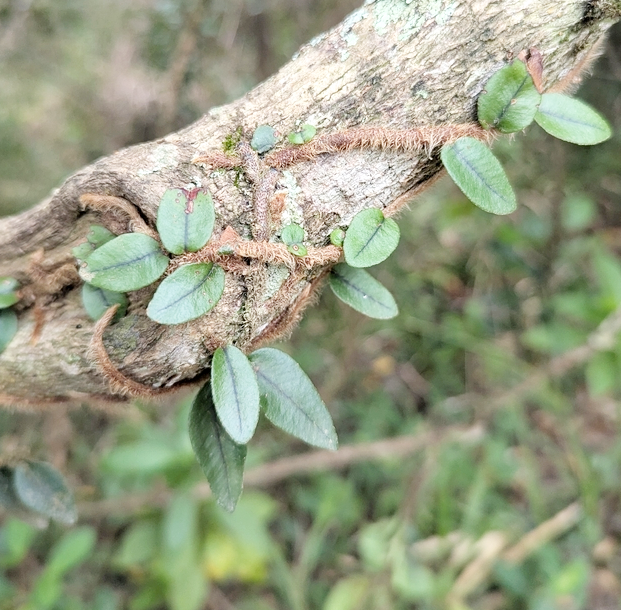
A single genus, Oleandra (30), from tropical America, Africa, Madagascar, east to Sri Lanka, Himalayas and S China south to Malaysia, east to Philippines, New Guinea and Queensland, through the Pacific. 14 spp. in New World, 8 in Brazil, 4 in Colombia, only one in Mexico.
POLYPODIACEAE
70 genera worldwide and 1,775 spp., mainly in tropics. 40 genera in Polypodiaceae do not occur in New World, namely Acrosorus (9, SE-Asia to Polynesia), Adenophorus (11, Hawaii), Aenigmatogrammitis (2, Moluccas, Australia), Archigrammitis (7, Borneo and Pacific islands), Boonkerdia (3, SE Asia), Bosmania (3, Madagascar, Japan and India to Sulawesi), Calligrammitis (2, Taiwan, Sri Lanka to New Guinea), Calymmodon (60, mostly Borneo and New Guinea, also Sri Lanka, SE Asia to Australia and Polynesia, Taiwan), Chrysogrammitis (2, tropical Asia), Ctenopterella (10, Old World), Dasygrammitis (8, tropical Asia, Pacific), Devolia (1, China, Japan), Dictymia (2, E Australia to Fiji and New Caledonia), Drynaria (33, Africa, tropical Asia to NE Australia), Glabrigrammitis (2, Sri Lanka, Taiwan, SE Asia to Vanuatu), Goniophlebium (32, Hokkaido and India to Australia), Grammitastrum (1, New Caledonia), Hovenkampia (3, Sudan and Guinea to South Africa), Howeogrammitis (1, Lord Howe, Australia), Lecanopteris (24, Vietnam to Australia and Vanuatu), Lepisorus (95, China, E & tropical Asia, one in Hawaii, few Africa, Madagascar and W-Pacific), Leptochilus (37, India to Hokkaido and New Guinea), Microsorum (42, paleotropical, extending to E Australia and New Zealand, eastward to Pacific, west to tropical Africa), Micropopypodium (3, China, Indochina, S Himalaya to Philippines), Nanogrammitis (7, E Africa, Madagascar, Seychelles, Mascarenes), Oreogrammitis (191, Asia, Pacific, Australia), Oxygrammitis (2, Philippines, Indonesia, Papua New Guinea), Pleurosoriopsis (1, Russia to C China and Japan), Podosorus (1, Philippines), Prosaptia (72, Asia), Pyrrosia (63, Cameroon to Uganda and tropical Africa, W Indian Ocean, Mongolia to tropical Asia and Pacific), Rouhania (7, Africa and Madagascar), Scleroglossum (10, tropical Asia and Australia), Selliguea (124, India to Hokkaido and Australia), Tomophyllum (37, tropical Asia to China, Australia, W-Pacific.), Thalassogrammitis (1, New Caledonia), Thylacopteris (3, Philippines and Sumatra to New Guinea) and Xiphopterella (14, tropical Asia).
Adetogramma ‣ monotypic, from Ecuador to N Argentina.
Alansmia ‣ 24 spp., mostly Neotropics, two in Africa. 14 spp. in Colombia, six in Brazil and 5 in Mexico.
Ascogrammitis ‣ 18 spp., Neotropics. Six spp. in Colombia, one in Mexico, unknown in Brazil.
Campyloneurum ‣ 76 spp., Mexico to Argentina, West Indies and Florida, 29 spp. in Colombia, 22 in Brazil and 11 in Mexico.
Ceradenia ‣ 77 spp. from tropical America, Indian Ocean and Africa, 25 in Colombia, 9 in Brazil and 5 in Mexico.
Cochlidium ‣ 17 spp., Neotropics, 1 to Africa and Indian Ocean. 7 spp. in Brazil, 5 in Colombia and three in Mexico.
Enterosora ‣ 28 spp., Neotropics, tropical Africa, Madagascar and Mascarenes. 5 spp. in Colombia, 3 in Brazil and two in Mexico.
Galactodenia ‣ 5 spp., Neotropics. Colombia and Mexico one each, unknown in Brazil.
Grammitis ‣ 28 spp., tropics. 4 spp. in Colombia, 3 in Brazil, absent in Mexico.
Lellingeria ‣ 52 spp., Neotropics. 19 spp. in Colombia, nine in Brazil and two in Mexico.
Leucotrichum ‣ 6 spp., Neotropics (5), and one in Madagascar. Two spp. in Brazil (both endemics), Colombia and Mexico one each.
Lomaphlebia ‣ two spp., Jamaica and Cuba one each.
Loxogramme ‣ 39 spp., mainly Guinea to Hokkaido, South Africa and New Guinea, and L. mexicana from Mexico to Panama.
Luisma ‣ a single species, endemic to Colombia (Risaralda).
Microgramma ‣ 35 spp., tropical & subtropical America, tropical & southern Africa, W Indian Ocean, India. 32 spp. in New World, 18 in Brazil, 15 in Colombia and six in Mexico.
Melpomene ‣ 30 spp., Neotropics one extending to tropical Africa. 17 spp. in Colombia, 11 in Mexico and 8 in Brazil.
Moranopteris ‣ 32 spp., tropical America, one in Madagascar. 13 spp. in Colombia, 9 in Brazil and three in Mexico.
Mycopteris ‣ 18 spp., Neotropics. 7 spp. in Colombia, Brazil and Mexico three each.
Niphidium ‣ 11 spp., tropical America. Six spp. in Colombia, two in Brazil, one in Mexico.
Notogrammitis ‣ 12 spp., Australia, New Zealand, South Africa, Antarctic islands, three of these in Argentina and Chile.
Parrisia ‣ two spp., one from Mexico to Brazil, another in Tanzania, Madagascar and La Reunion.
Pecluma ‣ 48 spp., Mexico to N Argentina, West Indies and Florida. 23 spp. in Colombia, 21 in Brazil and 15 in Mexico.
Phlebodium ‣ 3 spp., USA to Argentina and West Indies, all in Brazil and in Colombia, two in Mexico.
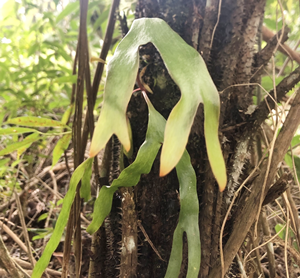
Platycerium ‣ 17 spp., 6-9 spp. in Africa/Madagascar, 7-10 from India and China to Australia, and P. andinum highly disjunct, known from mountain forests of SE Peru to NW Bolivia.
Pleopeltis ‣ 97 spp., mostly neotropical, very few in Africa, Madagascar and India. 35 spp. in Mexico, 21 in Colombia and 19 in Brazil.
Polypodium ‣ 51 spp. from New World, Marocco to Japan and southern Africa. 22 spp. in Mexico, 4 in Colombia and 3 in Brazil.
Serpocaulon ‣ 44 spp., Mexico to Argentina, West Indies, Florida. 26 spp. in Colombia, 19 in Brazil and 4 in Mexico.
Stenogrammitiss ‣ 25 spp., neotropics, Africa, Hawaii, Pacific. 5 spp. in Brazil, 4 in Mexico and 3 in Colombia.
Synammia ‣ 3 spp., Argentina, Chile and Juan Fernandez.
Terpsichore ‣ 16 spp., tropical America. 7 spp. in Colombia, 3 in Brazil and only one in Mexico.
GYMNOSPERMAE
Woody plants with pycnoxylic or manoxylic wood, the latter made up of tracheids, rarely of vessels. Venation of leaves dichotomous or derived therefrom. Gymnospermae is the name of the sister plant lineage of all flowering plants, charismatically well known for conifers.
KEY FOR GYMNOSPERMS
Growth monopodial, leaves palm-like or fern-like — Cycadopsida.
Growth monopodial, leaves neither palm-like nor fern-like.
Female (ovuliferous) organs drupe-like, leaves flabelliform — Ginkgopsida.
Female (ovuliferous) organs drupe-like and flabelliform leaves not occurring simultaneously — Pinopsida.
Are there are 7 orders of Gymnospermae, all forming a monophyletic group on the scale of botanical evolution. 4 of these occur in New World, and three in South America. It is quite surprising that Pinaceae is more reported to Gnethales than to the rest of the 'conifers'. A complete evolutive tree of Gymnospermae is available in Y.Yang et al. (Plant Diversity, 2022). A remarkable and complete list of all Gymnospermae genera and likely all gymnosperms species is available in The Gymnosperms Database (conifers.org).
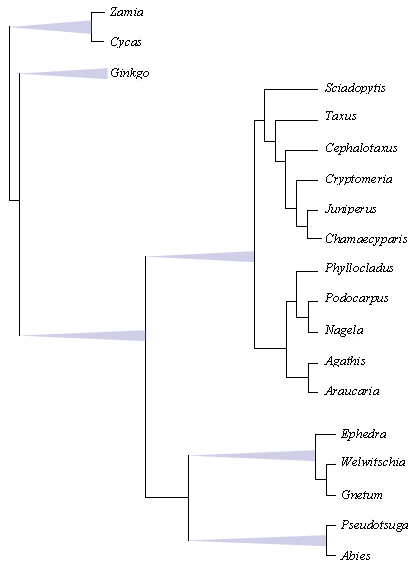
PHYLOGENY OF GYMNOSPERMS
A total of 88 Gymnospermae species occur in South America, distributed across 13 genera. Nearly 1/3 are palm-like cycads, while another 1/3 comprises tropical montane trees in the family Podocarpaceae, which may occur as shrubs or very tall trees; both groups include species endemic to Brazil. The remaining species comprise rainforest lianas of Gnetum, xeric to psammophilous, scandent or shrubby species of Ephedra, and woody-cone trees belonging to the families Araucariaceae and Cupressaceae. None of these latter groups includes species endemic to Brazil.
|
GUIANAS |
VENEZUELA |
COLOMBIA |
ECUADOR |
PERU |
BOLIVIA |
ARGENTINA |
CHILE |
BRAZIL |
PARAGUAY |
URUGUAY |
TOTAL |
| CYCADOPHYTA |
|
1/4 |
1/26(18ᴱ) |
1/5(1ᴱ) |
1/10(3ᴱ) |
1/2 |
|
|
1/7(1ᴱ) |
|
|
1/35 |
| GINKGOPHYTA |
|
|
|
|
|
|
|
|
|
|
|
|
| EPHEDRALES |
|
|
|
1/2 |
1/3 |
1/4 |
1/10(2ᴱ) |
1/8(2ᴱ) |
1/1 |
|
1/1 |
1/12 |
| WELWITSCHIALES |
|
|
|
|
|
|
|
|
|
|
|
|
| GNETHALES |
1/6 |
1/7 |
1/6 |
1/3 |
1/3 |
1/2 |
|
|
1/6 |
|
|
1/7 |
| PINALES |
|
|
|
|
|
|
|
|
|
|
|
|
| CUPRESSALES |
|
|
|
|
|
|
3/3 |
3/3 |
|
|
|
3/3 |
| ARAUCARIACEAE |
|
|
|
|
|
|
1/2 |
1/1 |
1/1 |
1/1 |
|
1/2 |
| PODOCARPACEAE |
1/2
| 4/16(1ᴱ) |
4/8 |
4/10 |
4/11 |
3/11(1ᴱ) |
4/6 |
4/5(1ᴱ) |
2/9(3ᴱ) |
|
|
6/29 |
|
TOTAL
|
2/8 |
6/27(1ᴱ) |
6/40(18ᴱ) |
7/20(1ᴱ) |
7/27(3ᴱ) |
6/19(1ᴱ) |
9/21(2ᴱ) |
9/17(3ᴱ) |
6/24(4ᴱ) |
1/1 |
1/1 |
13/88 |
Brazil has endemic species in three genera (Zamia, Retrophyllum, and Podocarpus), whereas Bolivia has endemic species in two genera. All other South American countries have endemic species in only one genus. At the family level, Brazil has endemic species in two families, Zamiaceae and Podocarpaceae, whereas each of the other countries has endemic species in only one family.
CLASS CYCADOPSIDA
CYCADALES
Two families worldwide, Zamicaeae widely in tropical areas from New World, Africa and Australia, and In Cycadaceae, the leaflets have a prominent midrib and lack conspicuous secondary veins, while in Zamiaceae, by contrast, the leaflets typically have multiple parallel veins, rather than a single prominent midrib (Conifers | Wisconsin Horticulture).
CYCADACEAE
Cycadaceae, with a single genus, Cycas (117), with diversity strongly concentrated in the Indo-Pacific region. The main centres of species richness are N Australia (〜33), mainland Southeast Asia (〜25), southern China (〜19), India and Sri Lanka (〜14), and the Indonesian–Philippine archipelagos (〜20), while smaller peripheral centres occur in East Africa and the western Indian Ocean (〜1), New Guinea and Melanesia (〜7), and the western and central Pacific (〜3). Northern Australia represents a particularly important and largely independent centre of diversity, whereas across tropical Asia and the Indo-Pacific, many species have highly restricted distributions, often confined to individual islands, provinces, mountain systems, or coastal regions, highlighting the strong geographical structuring, high endemism, and fragmentation that characterize the biogeography of the genus.
ZAMIACEAE
Zamiaceae includes 253 species in nine genera, with Dioon (18, Mexico to Honduras) emergings as the earliest-diverging lineage, followed by two major clades (M Calonje et al, PhytoKeys, 2026): [A] a predominantly Neotropical clade comprising Ceratozamia (38, Mexico to Honduras), Zamia (86, Mexico to C Brazil, up to Venezuela, and West Indies), and Microcycas (1, Cuba), together with Stangeria (1, South Africa, fern-like leaves) and Bowenia (2, Queensland); and [B] an Afro-Australian clade comprising Encephalartos (65, tropical Africa, from Ghana to Kenya, southern up to South Africa), Macrozamia (41, W, N & E Australia) and Lepidozamia (2, New South Wales, Australia).
KEY FOR CYCADOPHYTA (EXCLUDES BOWENIA, MICROCYCAS AND CERATOZAMIA)
Leaflets penniveined, with a definite midrib, fern-like plants — Stangeria
Leaflets lacking a midrib, superficially palm-like plants though sometimes small species.
Leaflets with a distinct articulation (not coloured swelling) at the base; cone scales in vertical rows — Zamia
Leaflets not articulated at the base; cone scales in spiral arrangement.
Leaflets not or hardly narrowed at the base; seeds on short stalks — Dioon
Leaflets clearly narrowed at the base; seeds not on stalks.
Cone scales with flattened 4 or 6-sided blunt ends; leaflets usually toothed — Encephalartos
Cone scales pointed or with a terminal spine; leaflets without toothed margins.
Leaflets joined to upper edge of midrib, not swollen or coloured at base; cones not or hardly stalked, scales without extended spines — Lepidozamia
Leaflets attached at midline of the midrib, swollen and coloured at the base; cones stalked, scales with erect spines — Macrozamia
Zamia comprises 87 species distributed throughout tropical America (POWO | Phytotaxa), 35 of which occur in South America. The highest species diversities are recorded in Colombia (26, 18ᴱ), Mexico (17, 13ᴱ), Panama (17, 12ᴱ, two extending into Colombia), Peru (8, 3ᴱ), Brazil (7, 1ᴱ), Cuba (6, 2ᴱ), Honduras (5, 3ᴱ), Guatemala (5, 2ᴱ), Costa Rica (5, 1ᴱ), Ecuador (5, 1ᴱ), Belize (4, 2ᴱ), Venezuela (4), Puerto Rico (3, 1ᴱ), Bahamas (3, 1ᴱ), Jamaica (2), USA (1), Cayman Islands (1), Nicaragua (1) and the Republica Dominicana (1).
In our text, we also considered Z. multidentata to occur in Peru, as well as the species Z. urarinorum, both of which were absent from the POWO records as of September 2016 (Calonje et al, Phytotaxa, 2026 | POWO/Zamia).
Among the Cycads genera, Zamia has the greatest diversity in growth habits and habitats where species are distributed. Some species have solitary arborescent trunks, reaching until 10 m of height and 20 cm of diameter; others have subterranean rhizomes of few centimeters, even there an epiphytic species endemic to Panama, other species grows in rocky-cliffs. Zamia species have smooth stems, without any evident leaf scars, rarely branched. Leaves in Zamia can be from less a meter to 5 meters of length, with numerous tiny leaflets (up to more 100) or a few large leaflets (2 - 10). Morphological variation of the reproductive structures (pollen and seed cones) is low, but there is a variety of sizes and colors in this structures. Zamia species grow in a wide variety of habitats, such as beach dunes, xerophytic formations, cliffs, tropical savannas (Z. boliviana), permanent wet areas (Z. urarinorum), dry forest, humid, montane forests, and even mangroves (Colombian Zamia).
All analyses recovered the same broad topology consisting of the following geographically delimited major five clades: (1) West Indies clade, consisting mostly of West Indies Island species (Z. integrifolia up to Florida), which is sister to the rest of the genus consisting of primarily of mainland American species; (2) Fischeri clade, consisting of three Mexican endemic species and is itself sister to the rest of the genus excluding the West Indies clade; (3) Mesoamerica clade, including all other species occurring in Mesoamerica to the exclusion of the Fischeri clade and Z. soconuscensis; (4) Isthmus clade, consisting primarily of Panamanian and Costa Rican species; and (5) South America clade, consisting primarily of South American endemic species (Calonje et al., International Journal of Plant Science, 2019).
BRAZILIAN SPECIES
Brazilian species includes Z. amazonum D.W. Stev. (Venezuela to Peru and Brazil, DESCRIPTION), Z. boliviana (Brongn.) A. DC. (Bolivia to Mato Grosso state), Z. brasiliensis R. Segalla & Calonje (E Rondonia to NW Mato Grosso states, Segalla & Calonje, Phytotaxa, 2019), Z. lecointei Ducke (Venezuela, Colombia and Brazil, HISTORY), Z. poeppigiana Mart. & Eichler (N & C Peru to Acre state in Brazil, MAP, included in Colombia by Biovirtual/SEE, excluded by CZ/SEE and several other sources), Z. ulei Dammer (Venezuela to Bolivia and Brazil), and Z. multidentata Calonje, Segalla & R.S.Pimenta (W Acre state and E Peru, Segalla et al., Phytotaxa, 2023 | Phytotaxa).
REMARKABLE SPECIES
Zamia pseudoparasitica J.Yates in B.Seemann from Panama is the only known species in this genus that is epiphytic, growing on the branches of forest trees (Wikipedia). A high remarkable beetle from Brazil (and Bolivia) is the Pharaxonotha cerradensis (Erotylidae), highly associated with Z. boliviana (Brongniart) A. DC. (Skelley & Segalla, Zootaxa, 2019). Z. roezlii Regel ex Linden, native to the rainforests of Colombia and Ecuador, is the tallest of all Zamia species (Palm Society), and has the longest sperm produced by a plants, measuring approximately 0.4 mm long and is therefore visible to the naked eye (Guiness World Record). Z. montana A.Braun is the highest elevation cycad in the world, found at 2,700m above sea level in Antioquia, Colombia (Palm Society). Ecological and conservatioal data for Zamia is available in Segalla, R. et al. (Tropical Conservation Science, 2019). For Colombian Zamia data, links and descriptions, see Biovirtual/Flora de Colombia. Z. urarinorum Calonje, R. Zárate & M.Asa Jones, endemic to NW Peru in Loreto departament, is the only cycad known to inhabit permanently waterlogged wetland forests, a unique and ecologically challenging environment (Calonje et al, Phytotaxa, 2026).
| ● Zamia obliqua |
| ■ Colombian endemic Zamia |
| ● Zamia manicata |
| ● Zamia muricata |
| ● Zamia roezlii |
| ● Zamia gentryi |
| ■ Zamia lindeni |
| ■ Zamia ulei |
| ■ Zamia amazonum |
| ■ Zamia lecointei |
| ● Zamia macrochiera |
| ■ Zamia hymenophyllidia |
| ■ Zamia urarinorum |
| ■ Zamia poeppigiana |
| ■ Zamia multidentata |
|
● Zamia urep
|
| ● Zamia boliviana |
| ■ Zamia brasiliensis |
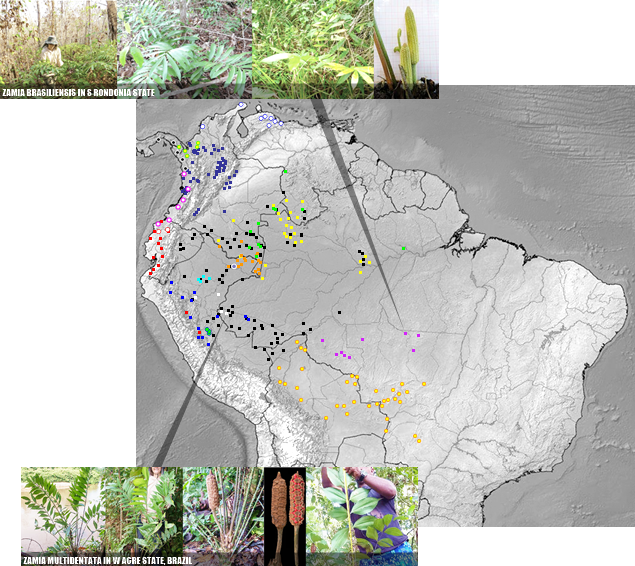
HIGH ACCURATE DISTRIBUTION OF ZAMIA IN SOUTH AMERICA, AND IMAGES IN SITU FOR SOME BRAZILIAN SPECIES
18 species are endemic to Colombia (Z. amplifolia, Z. chigua, Z. disodon, Z. encephalartoides, Z. huilensis, Z. imbricata, Z. incognita, Z. lindosensis, Z. melanorrhachis, Z. montana, Z. oligodonta, Z. orinoquiensis, Z. paucifoliolata, Z. pyrophylla, Z. restrepoi, Z. sinuensis, Z. tolimensis, Z. wallisii).
Two species from Colombia to Panama (Z. manicata, Z. obliqua).
Z. muricata, Z. roezlii and Z. hymenophyllidia from Colombia up to Venezuela, Ecuador and Peru, respectively.
Three widely in northern South America, Z. amazonum, Zamia lecointei and Z. ulei, all from Brazil, Colombia, Peru and Venezuela (Z. amazonum also in Ecuador, and Z. ulei also in Bolivia).
Endemic in Ecuador (1, Z. gentryi), Peru (3, Z. macrochiera, Z. urep, Z. urarinorum) and Brazil (1, Z. brasiliensis).
Four locally unknown in Colombia, namely Z. lindenii in Peru and Ecuador; Z. poeppigiana and Z. multidentata from Brazil and Peru; and Z. boliviana in Brazil and Bolivia.
Zamia obliqua A.Braun
Arborescent up to 5m tall (Biovirtual). S Panama to NW Colombia.
Zamia manicata Linden ex Regel
Subterranean stem (Biovirtual). S Panama to NW Colombia.
Zamia muricata Willd.
Semi-subterranean and semiarborel stems (Biovirtual). La Guajira peninsula in N Colombia to coastal places in NW Venezuela.
Zamia amplifolia Mast.
Arborescent up to 2.5m tall. Valle departament in NW Colombia (Biovirtual).
Zamia chigua Seem.
Arborescent up to 2.5m tall, the most fern-like species in South America. Choco and Valle departaments in W Colombia (Biovirtual).
Zamia disodon D.W.Stev. & Sabato
Subterranean stem, known from Antioquia departament in Colombia (Biovirtual).
Zamia encephalartoides D.W.Stev.
Arborescent up to 2m tall, knwon from Santander departament in NE Colombia (Biovirtual).
Zamia huilensis Calonje, H.E.Esquivel & D.W.Stev.
Arborescent up to 1.1m tall, known from Huila departament from Colombia (DESCRIPTION).
Zamia imbricata Calonje & J.Castro
Hypogeous to semi-hypogeous stems. Caldas departament in Colombia (DESCRIPTION).
Zamia incognita A.Lindstr. & Idarraga
Subterranean stems, known from Madalena valley in Colombia (PDF).
Zamia lindosensis D.W.Stev.
Subterranean stems, endemic to the Serrania de la Lindosa, in the Guaviare department in SE Colombia (Cycadas Colombia).
Zamia melanorrhachis D.W.Stev.
Subterranean stems, knwon in several departaments in N Colombia (Biovirtual).
Zamia montana A.Braun
Arborescent up to 1.5m tall, in montane forests from 1800-2400m tall in Antioquia departament from Colombia (Biovirtual).
Zamia oligodonta Calderón & D.W.Stev.
Stems typically subterranean, rarely arborescent, known from Risaralda, Colombia (PDF).
Zamia orinoquiensis Calonje, Betancur & A.Lindstr.
Subterranean stems, known from savannas of Casanare, Cundiramarca and Meta departaments in Colombia (DESCRIPTION).
Zamia paucifoliolata Calonje
Subterranean stems, known form Valle del Cauca, Colombia (DESCRIPTION).
Zamia pyrophylla Calonje, D.W.Stev. & A.Lindstr.
Subterranean stems, known from Chocó departament in NW Colombia (DESCRIPTION).
Zamia restrepoi (D.W.Stev.) A.Lindstr.
Subterranean stems (Wikipedia), endemic to Antioquia in NW Colombia, known for fewer than 100 adult specimens. Former Chigua restrepoi D.W.Stev., in Chigua, a genus based on weakly characters, such as peculiar raised or conspicuous bumps at each angle of the hexagonal megasporophyll face, known also in other South American Zamia, synonimized in Lindstorm (Taxon, 2009).
Zamia sinuensis Calonje & J.Castro
Hypogeous to semi-hypogeous stems. Cordoba departament in Colombia (DESCRIPTION).
Zamia tolimensis Calonje
Arborescent up to 4m tall (Calonje et al, Brittonia, 2011). Colombia (Tolima) (MAP).
Zamia wallisii H.J.Veitch
Subterranean stems, endemic to Antioquia departament in N Colombia (Biovirtual).
Zamia roezlii Regel ex Linden
Arborescent up to 7m tall, known in SW Colombia to NW Ecuador (Biovirtual).
Zamia gentryi Dodson
Arborescent up to 1m tall, known from Carchi and Esmeraldas provinces in NW Ecuador (Dodson, Novon, 1998).
Zamia lindenii Regel ex André
Arborescent up to 4m tall (Calonje et al, Brittonia, 2011). W Ecuador to NW Peru (MAP).
Zamia amazonum D.W.Stev.
Subteranean stems. SE Colombia, S Venezuela, Amazonas state in NW Brazil and N Peru (DESCRIPTION).
Zamia lecointei Ducke
Subteranean stems. SE Colombia, S Venezuela, N Peru, Amazonas and Pará states in N Brazil (DESCRIPTION).
Zamia ulei Dammer
Subteranean stems. S & SE Colombia, S Venezuela, E Ecuador, N & C Peru, N Bolivia, Acre, Rondonia and Amazonas states in N Brazil, sometimes reported also in Pará states but rejected here in this state (MAP | Biovirtual). It includes the species henceforth recognized as Zamia cupatiensis Ducke from SE Colombia and NW Amazonas state in Brazi (Reflora).
Zamia hymenophyllidia D.W.Stev.
Subteranean stems, similar to Z. melanorrachis by extreme long penduncles, unique among Cycadales. SE Colombia to N Peru, strogly near Brazilian border (Biovirtual | PDF).
Zamia macrochiera D.W.Stev.
N Peru.
Zamia urarinorum Calonje, R. Zárate & M.Asa Jones
Arborescent, the only cycad known to inhabit permanently waterlogged wetland forests, a unique and ecologically challenging environment. Wetland forests in the Tigrillo and Urituyacu river basins of Loreto, Peru (PDF).
Zamia multidentata Calonje, Segalla & R.S.Pimenta
Arborescent. NE Peru to Acre state in E Brazil (PDF).
Zamia poeppigiana Mart. & Eichler.
Arborescent up to 3m tall (Calonje et al, Brittonia, 2011). N & C Peru to Acre state in W Brazil (MAP).
Zamia urep B.Walln.
Subteranean stems. Huanuco departament in Peru (PDF).
Zamia brasiliensis Calonje & Segalla
Rondônia and Mato Grosso states in WC Brazil (MAP).
Zamia boliviana (Brongn.) A.DC.
Mato Grosso, Rondonia and Mato Grosso do Sul state in Brazil and E Bolivia; former Ceratozamia boliviana Brongn. (MAP).
2 CLASS GINKGOOPSIDA
GINKGOALES
A single family.
GINKGOACEAE
A single genus and species, Ginkgo biloba L., a living fossil, once widespread but thought extinct in the wild for centuries, is now commonly cultivated in East Asia, with some genetically diverse populations possibly representing rare wild survivors in southwestern China's mountainous regions (Wikipedia).
3 CLASS PINOPSIDA
Pinopsida is an exceptionally diverse group of Gymnospermae, encompassing mainly boreal and subtropical conifers, tropical rainforest lianas of Gnetum, xeric and psammophilous shrubs of Ephedra, and the highly specialized, extreme succulent xerophyte Welwitschia from SW Africa.
KEY PINOPSIDA
Reproductive structures exhibiting gnetalean features — Gnetidae
Reproductive structures lacking gnetalean features
Leaves predominantly needle-like, characteristic of Pinaceae — Pinidae
Leaves not characteristically Pinaceae-like — Cupressidae
GNETIDAE
Woody plants, leaves opposite or whorled, simple, broadly elliptic, strap-shaped, or scale-like; secondary xylem with foraminate vessels. Plants dioecious, rarely monoecious.
KEY GNETHIDAE
Vines or erect woody plants with nodose branches and decussate, pinnately veined leaves — Gnetum
Branches not nodose, leaves not pinnately veined, strobili not in definite rings.
Equisetoid woody plants with scale-like opposite or whorled leaves — Ephedra
Plant with only one unbranched, cone-shaped woody stem and a single pair of foliage leaves of unlimited growth — Welwitschia
GNETALES
A single family and genus.
GNETHACEAE
A single genus, Gnetum L., formed by dioecious, evergreen, mostly woody vines, rarely shrubs or trees; stems with swollen nodes; leaves opposite, petiolate, without stipules, simple, elliptic, with pinnate veins and entire margins; usually with drip tips; both male and female megastrobili terminal or lateral, sometimes arranged in dense, cauliflorous clusters on old stems; male strobilus consists of a stamen and perianth, the female strobilus of an ovule with 2 integuments and perianth (these structures are usually associated with angiosperms, one of the points that traditionally places Gnetum in an ambiguous state intermediate between the gymnosperms and angiosperms); seeds drupelike, enclosed in a red, orange, or yellow, fleshy (rarely corky) false seed coat.
| ■ Gnetum paniculatum |
| ■ Gnetum nodiflorum |
| ● Gnetum camporum |
| ■ Gnetum urens |
| ■ Gnetum schwackeanum |
| ■ Gnetum venosum |
| ■ Gnetum leyboldii |
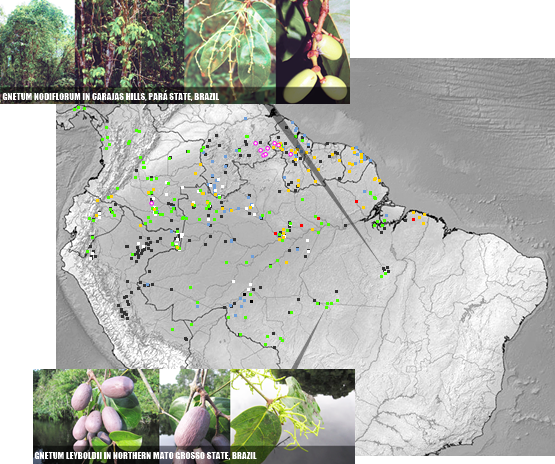
MODERATE ACCURATE DISTRIBUTION OF THE 7 SPECIES FROM GNETUM OF THE AMERICAS, AND SOME IMAGES IN SITU IN BRAZIL
44 spp. in tropical zones of the World, from Nigeria to Angola (4), SE China and Assan to Indochina, Philippines and Sumatra to Queensland and Vanuatu (33), and from Costa Rica to Bolivia and N Brazil (7). South American species of Gnetum being sister to the remaining species. The four African species constitute a monophyletic group, sister to an Asian clade, within which the two arborescent species of the genus are the earliest diverging. Species ranked from the most widely distributed to the rarest.
Gnetum leyboldii Tul.
Costa Rica to Panama, W Colombia to C Guyana, E Ecuador, N Peru, N Brazil up to Mato Grosso and Para states. Map below based on GBIF (⌨, including Guyana), Cavalcante (Acta Amazonica, 1978), Mota & Giulietti (Rodriguésia, 2016) and Zappi et al. (Acta Amazonica, 2011).
Gnetum nodiflorum Brongn.
S & SE Colombia to French Guiana, E Ecuador to S Peru, N Brazil up to Mato Grosso and Pará states, scattered in N Bolivia. Map below based on GBIF (⌨), Cavalcante (Acta Amazonica, 1978), Mota & Giulietti (Rodriguésia, 2016) and Zappi et al. (Acta Amazonica, 2011).
Gnetum schwackeanum Taub. ex Schenck
SE Colombia, NE Peru, S Venezuela and Amazonas states in N Brazil, with isolate records in C Colombia, C Guyana, E Ecuador, N Peru and Carajas ills in Pará state in Brazil. Map below based on GBIF (xx, including Peru and Ecuador), Cavalcante (Acta Amazonica, 1978), Mota & Giulietti (Rodriguésia, 2016) and Zappi et al. (Acta Amazonica, 2011).
Gnetum paniculatum Spruce ex Benth.
SE Colombia and S Venezuela to Amazonas state in N Brazil, Guyana and French Guiana, with isolated records in Acre and Rondonia states in N Brazil. Map below based on GBIF (⌨), Cavalcante (Acta Amazonica, 1978), Mota & Giulietti (Rodriguésia, 2016) and Zappi et al. (Acta Amazonica, 2011).
Gnetum urens (Aubl.) Blume
N Ecuador, S & SE Colombia, S Venezuela, Amazonas and Roraima states in N Brazil, Guyana to Amapá, and NE Pará state. Map below based on GBIF (⌨, also in Ecuador, excluding records from America Central and W Colombia), Cavalcante (Acta Amazonica, 1978), Mota & Giulietti (Rodriguésia, 2016) and Zappi et al. (Acta Amazonica, 2011). Former Thoa urens Aubl.
Gnetum venosum Spruce ex Benth.
Venezuela (Bolívar), Amazonas to Pará state in N Brazil. Rejected in Venezuela in Jáuregui & Rojas (Acta Botánica Venezuelica, 2005). Map below based on GBIF (⌨), Cavalcante (Acta Amazonica, 1978), Mota & Giulietti (Rodriguésia, 2016) and Zappi et al. (Acta Amazonica, 2011).
Gnetum camporum (Markgr.) D.W.Stev. & Zanoni
S Colombia, S Venezuela to W Guyana. Former G. urens var. camporum Markgr. Cited as a Venezuelan endemic in Jáuregui & Rojas (Acta Botánica Venezuelica, 2005). Map below based on GBIF (⌨), except for Brazilian record, possibly a mistake.
The wood contain tracheids and is otherwise typical of Gymnospermae, but also contains vessels, another angiosperm trait, thought in this case to have arisen independently, without phylogenetic significance.
WELWITSCHIALES
A single family.
WELWITSCHIACEAE
A single genus and species, Welwitschia mirabilis Hook.f., native to SW Angola to C Namibia, near coast in Namib desert, where it grows in the extreme conditions of the Namib desert, tolerating high heat and low precipitation (Wikipedia).
EPHEDRALES
A single family and genus.
EPHEDRACEAE
A single xeric genus, Ephedra Tourn. ex. L., formed by perennial, dioecious (rarely monoecious), erect, procumbent or climbing shrubs or vines; bark grey to reddish brown, cracked and fissured, often fibrous; branching is often broom-like with nearly parallel and fastigiate to ascending green stems; branches photosynthetic, yellowish green to olive-green when young, round, finely longitudinally grooved, jointed, internodes 1-10 cm; leaves mostly not photosynthetic; vessels most abundant and largest in lianoid species, whilst nearly lacking in alpine species.
73 spp. worldwide, several restricted for a single zone, namely in Canary islands to Mediterranean zone (5), N Africa to NW India (2), N Africa from Chad to Somalia (3), Balkan, Middle East to C Asia and Himalayas, up to NE Aasia from Mongolia to S Siberia and NE China (36), NW USA to C Mexico (13, 12 in USA, 8 in Mexico-1 endemic) and W to S & SE South America (12), plus two widespread species, E. distachya L. (Europe to N China and Caucasus, S Russian Far East) and E. foeminea Forssk. (SE Europe to NE tropical Africa).
Ephedra rupestris Benth.
Plants low, depressed or even prostrate, but to 0.6 m tall, forming dense cushions, Ecuador to NW Argentina, at 1900-4600 m elevation in grassy páramo with rocky outcrops in windswept areas, growing in gravelly or sandy soil (TGD).
Ephedra americana Humb. & Bonpl. ex Willd.
Dioecious shrubs, or trees up to 3.5 m tall, or creeping subshrubs, from Ecuador to NW Argentina, found at 1500-4100 m elevation, in shrubby grassland, scrub, or semi-desert, often associated with cacti on dry rocky slopes and hills or on sandy/clayey soils (TGD).
Ephedra breana Phil.
Dioecious shrubs, from SE Peru to NW Argentina (TGD).
Ephedra triandra Tul.
Dioecious, rhizomatous shrub to 2 m tall, or climbing, from Argentina and Bolivia, at elevations of 300 to 3000 m in semi-arid areas, often in disturbed areas, in sandy soil on rocky hillsides, in gulches and on clay bluffs (TGD).
Ephedra boelckei F.A.Roig
Dioecious shrubs with 3-5 trunks, or a short tree up to 5 m tall with a single trunk (one of the few species of Ephedra that can grow as a tree), known from NW Argentina (TGD).
Ephedra chilensis C.Presl
Dioecious subshrubs or shrubs to 1.5 m tall, in Argentina (Mendoza, Neuquén) and Chile (Maule, Valparaíso, Antofagasta, Santiago), perhaps Bolivia, at elevations of 300-3850 m in shrubland, rocky areas, and desert (TGD).
Ephedra frustillata Miers
Dioecious shrubs up to 20 cm tall, prostrate to ascending, with green to yellowish branches, Tierra del Fuego to N in Argentina to 42° S and in Chile to 51° S (TGD).
Ephedra gracilis Phil. ex Stapf
Endemic to Atacama and Coqimbo in Chile; the IUCN treats E. gracilis as a synonym of E. chilensis, so conservation assessments for the two taxa are conflated (TGD).
Ephedra multiflora Phil. ex Stapf
Dioecious shrubs, erect, up to 1.5 m tall. known from Antofagasta in Chile and Catamarca to Neuquén in Argentina (TGD).
Ephedra ochreata Miers
Dioecious shrubs up to 1 m tall, endemic to Catamarca to Santa Cruz in S Argentina (TGD).
Ephedra trifurcata Zöllner
Dioecious or monoecious shrubs up to 2 m tall, with thin, flexible, gnarled branches, endemic to Chile in Valparaíso (TGD | DESCRIPTION).
Ephedra tweedieana C.A.Mey.
E Rio Grande do Sul state in S Brazil to NE Argentina along Uruguay, at elevations of 0-1000 m, in moist forests including Atlantic Forest, and woods, generally in wetter conditions than other Ephedra (iNaturalist | TGD).
Ephedra has 5 clades. Among the Old World species, three highly-supported monophyletic groups are recognized, that are highly concordant with morphological evidence. The New World clade includes two main subclades of North and South American species that are strongly supported, while the position of two, mostly Mexican species E. pedunculata and E. compacta remains unresolved. Although all South American species belong to one highly-supported clade, relationships among these species are not well resolved, except the clade including E. tweediana, E. triandra, and E. chilensis. Molecular analysis has found E. rupestris, E. triandra and E. tweedieana to comprise a basal clade sister to the other South American species of Ephedra (TGD).
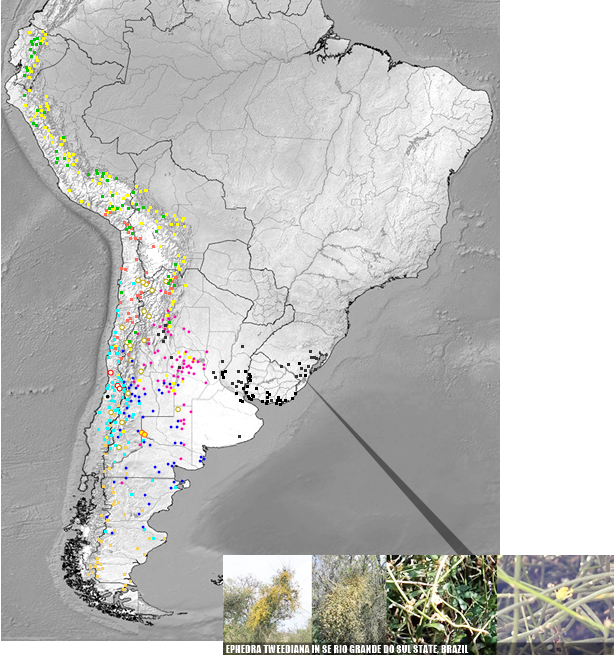
| ■ Ephedra americana |
| ■ Ephedra rupestris |
| ■ Ephedra breana |
| ● Ephedra gracilis |
| ■Ephedra chilensis |
| ● Ephedra boelcki |
| ● Ephedra multiflora |
| ● Ephedra triandra |
| ● Ephedra trifurcata |
| ● Ephedra ochreata |
| ■ Ephedra fristillata |
| ■ Ephedra tweediana |
MODERATE ACCURATE DISTRIBUTION OF THE 12 SPECIES FROM EPHEDRA IN SOUTH AMERICA (GBIF | iNATURALIST)
PINIDAE
PINALES
A predominantly northern Hemisphere group of shrubs and trees, all in Pinaceae.
PINACEAE
Pinaceae ranges from 2 to 100 m in height, mostly evergreen (with the exception of the deciduous genera Larix and Pseudolarix), resinous, and monoecious. Plants typically exhibit subopposite or whorled branching and spirally arranged, linear, needle-like leaves (Wikipedia). The group comprises nine genera and 249 species, namely Cedrus (4, NW Africa, E Mediterranean to Himalaya), Cathaya (1, S China), Nothotsuga (1, S China), Pseudolarix (1, E China), Keteleeria (4, C & S China to Indochina, Taiwan), Pseudotsuga (4, China to temperate E Asia, North America), Tsuga (10, Himalaya to temperate E Asia, Alaska to Canada and USA), Larix (10, temperae & subarctic northern Hemisphere), Picea (37, temperate northern Hemisphere), Abies (49, temperate Eurasia to Indochina, Alaska to Honduras) and Pinus (128, northern Hemisphere).
CUPRESSIDAE
With recent advances in gymnosperm phylogeny, Pinidae, including Pinaceae, and Gnetidae are recognized as sister groups, together forming a clade separate from Cupressidae. Within Cupressidae, the two major orders, Araucariales and Cupressales, can be distinguished using the following dichotomous key.
Female reproductive structures generally composed of several fertile units (ovuliferous scales or scale complexes), with more than one ovule associated with the reproductive structure; cones typically recognizable, although variably modified — Araucariales.
Female reproductive structures strongly reduced, commonly consisting of a single terminal or solitary ovule, or of a very small number of highly modified ovuliferous structures; typical multicompartmented ovulate cones absent or highly reduced — Cupressaceae.
Almost all Cupressidae are green trees, from thin trees to trees over 100m, with a remarkable variety of leaf shapes and branch architecture. However, three genera, all of Podocarpaceae, escaped this pattern, namely one in New Caledonia (Parasitaxus, purpure holoparasitic) and two in New Zealand (Holocarpus and Lepidothamnus, with members as shrubs, sometimes very small), the second of which also occurs in South America.
ARAUCARIALES
Two families. Podocarpaceae has a predominantly Southern Hemisphere distribution, extending from South America and southern Africa through Australasia and Southeast Asia to the Pacific Islands. Its greatest diversity occurs in Australasia and Malesia, with several genera extending northward into tropical Asia. Araucariaceae has a more restricted and disjunct distribution, occurring naturally in South America and Australasia, particularly southern Brazil, Argentina, Chile, Australia, New Guinea, and New Caledonia. Thus, while both families are characteristic of the Southern Hemisphere, Podocarpaceae has a considerably broader distribution across tropical and temperate regions, whereas Araucariaceae is concentrated in a few widely separated Gondwanan regions.
Female cones usually reduced or highly modified; seeds often associated with a fleshy epimatium or receptacle; leaves variable, frequently narrow or scale-like — Podocarpaceae
Female cones large, woody and compact, composed of numerous scales; each scale bearing a single seed; leaves generally broad or needle-like and rigid — Araucariaceae
ARAUCARIACEAE
Trees, highly resinous monoecious or dioecious, evergreen; leaves simple, entire, usually long-persistent, in oppos1te-subopposite pairs or spirally arranged, monomorphic or polymorphic, small and awl-like to large and flattened, adnate or shortly petiolate.
Leaves opposite or subopposite, shortly petiolate, distant on shoot; seeds winged; ovules not united with the scale
— Agathis (17, Philippines, Malaysia, Indonesia, Papua New Guinea, Vanuatu, New Caledonia, Australia and New Zealand).
Leaves spirally arranged, sessile or nearly sessile, crowded on shoot; seeds not winged; ovules united with the scale.
Leaves broad, lanceolate to ovate-lanceolate, spreading from shoot; seed cones large, globose to ovoid, scales separating individually at maturity — Araucaria (21).
Leaves narrow, linear-lanceolate, coriaceous, densely crowded on shoot; seed cones globose, scales and seeds falling together at maturity
— Wollemia (1, known only from Wollemi National Park in New South Wales, SE Australia).
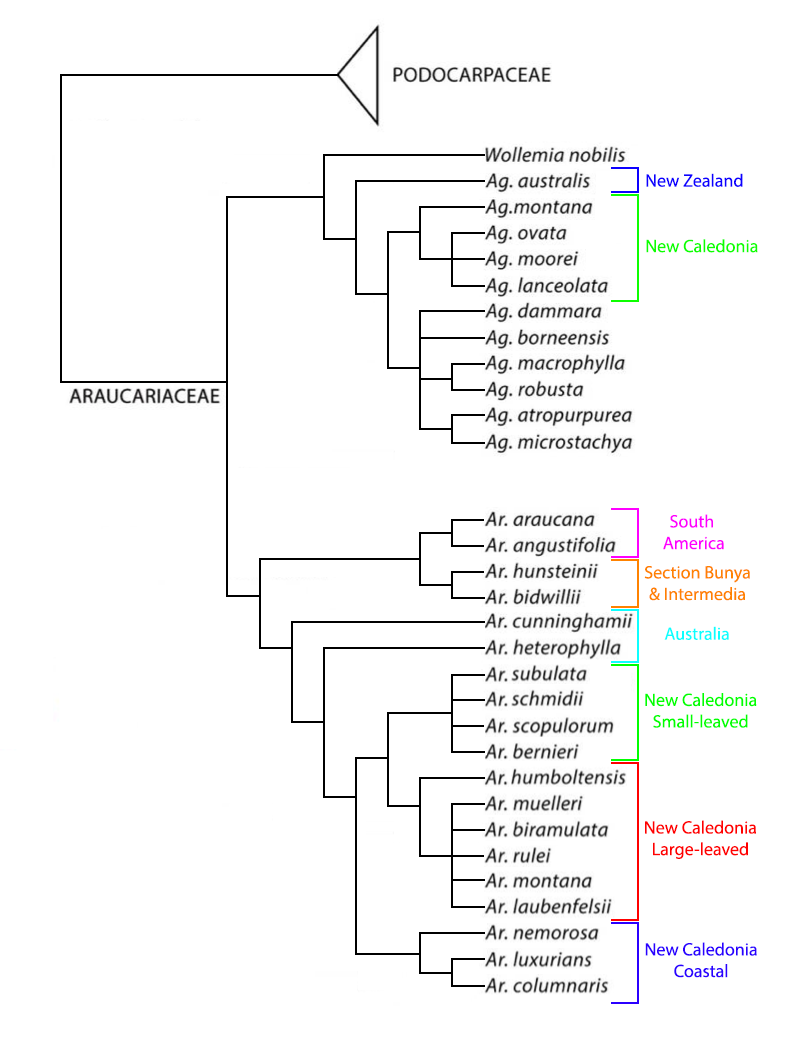
PHYLOGENETIC TREE FOR THE ARAUCARIACEAE, MODIFIED FROM ESCAPA & CATALANO (2013) AND GADEUL ET AL. (2012)/TGD
Araucaria (21) includes evergreen trees with regularly whorled branches, in four well defined clades (TGD), namely sect Araucaria (2, South America), sect Bunya (2, New Guinea, one up to Queensland), basal sect Eutacta (2, Australia and Norfolk island) and strict sect Eutacta (14, exclusive from New Caledonia).
Araucaria angustifolia (Bertol.) Kuntze
Trees, dioecious, 25–35(–52) m tall, with a straight trunk and horizontal branches, the crown becoming flat-topped with age, known in montane forests 500–1,500(–2,300) m of SE & S Brazil (Minas Gerais to Rio Grande do Sul states) to Misiones province in Argentina, also in E Paraguay, at 500–2,300 m (TGD). Former Columbea angustifolia Bertol.
Araucaria angustifolia is probably the most famous and charismatic conifer of the southern Hemisphere. It also likely has the largest and most extensive contiguous distribution among southern Hemisphere conifers, although some african Juniperus and andean Podocarpaceae have more elongated ranges. It is also one of the most recognizable trees in Brazil and one of the species most deeply embedded in the country’s popular culture and collective national identity.
Araucaria araucana (Molina) K.Koch
Trees, dioecious, up to 40 m tall, SC Chile to Neuquén privince in Argentina, in a very small area (TGD). Former Pinus araucana Molina.
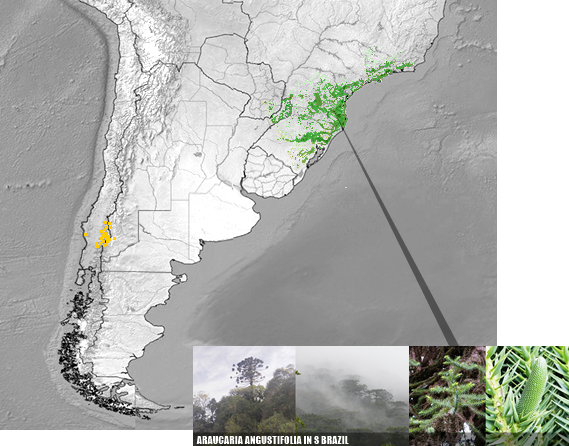
| ■ Araucaria angustifolia |
| ▪ Araucaria araucana |
ARAUCARIACEAE FROM SOUTH AMERICA, MAP AND IN SITU IMAGES
PODOCARPACEAE
Slightly resinous, dioecious or rarely monoecious, evergreen shrubs or trees, leaves simple, entire, linear, often long-persistent, usually spirally arranged, highly variable in form, from large, linear, and flattened to scale-like, distant or crowded. Female (ovuliferous) cones terminal or axillary, usually solitary, varying much in complexity between the genera, of one or many bracts, each or only one of each bearing one ovule, sometimes with several further fused, reduced bracts which are adnate to the rachis and form a basal peduncle ('receptacle') which may be either dry or become fleshy and succulent after fertilization.
Podocarpaceae (20/197) is the tropical counterpart of Pinaceae (9/249), although it is less species-rich. The two families overlap only from Mexico to Nicaragua, in the West Indies, China, Japan, northeastern India, Bangladesh, Indochina, Sumatra, and the Philippines.
BIOGEOGRAPHY
Podocarpaceae has a major center of diversity in the Asia–Pacific region (including 18 of 20 genera in this family), excluding Australia, where 8 genera are restricted to this region, namely Nageia (5, Japan to India and Sulawesi), Dacrycarpus (9, S China to Indochina and the SW Pacific to New Zealand), Dacrydium (21, SE China to Indochina and the S Pacific and New Zealand), Falcatifolium (6, Philippines and Malesia to New Caledonia), Acmopyle (2, Fiji and New Caledonia), Parasitaxus (1, New Caledonia), Halocarpus (3, New Zealand), and Manoao (1, New Zealand), including three genera endemic to individual countries. SE Australia and Tasmania harbor 3 additional endemic genera, namely Lagarostrobos (2, Tasmania), Microcachrys (1, Tasmania), and Pherosphaera (2, SE Australia). Two other genera occur collectively in the region, Phyllocladus (5, Malesia to New Guinea, Tasmania to New Zealand) and Sundacarpus (1, Borneo and Java to northeastern Australia). Altogether, this arc encompasses 13 of the 20 genera of the family exclusively.
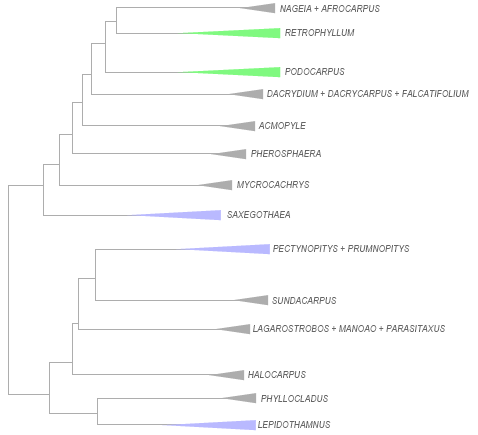
PHYLOGENY OF PODOCARPACEAE (R. KHAN ET AL., MDPI, 2023), FOCUSING ON NEW WORLD GENERA ABSENT FROM (PURPLE) AND PRESENT IN BRAZIL (GREEN)
Four genera occur in this region and also reach the Americas, namely Lepidothamnus (3, 2 in New Zealand and 1 from S Chile to S Argentina), Pectinopitys (6, NE Australia-1, New Caledonia-1, New Zealand-1, Costa Rica-1, NW Venezuela to Bolivia-2), Prumnopitys (3, New Zealand-1, NW Venezuela to Peru-1, Argentina and Chile-1), and Retrophyllum (6, from Maluku to the SW Pacific, Venezuela to Bolivia-1 and WC Brazil-1). Their American representatives occur essentially in the tropical Andes, with outliers in Costa Rica and the Araucaria region of southern South America.
Two genera are distinctly absent from this region, the tropical African Afrocarpus (5, São Tomé, Ethiopia to South Africa), restricted to Africa, and Saxegothaea (1, S Argentina and SC & S Chile), restricted to the southernmost part of South America.
Podocarpus (116) is pantropical and co-occurs with nearly all other genera of the family.
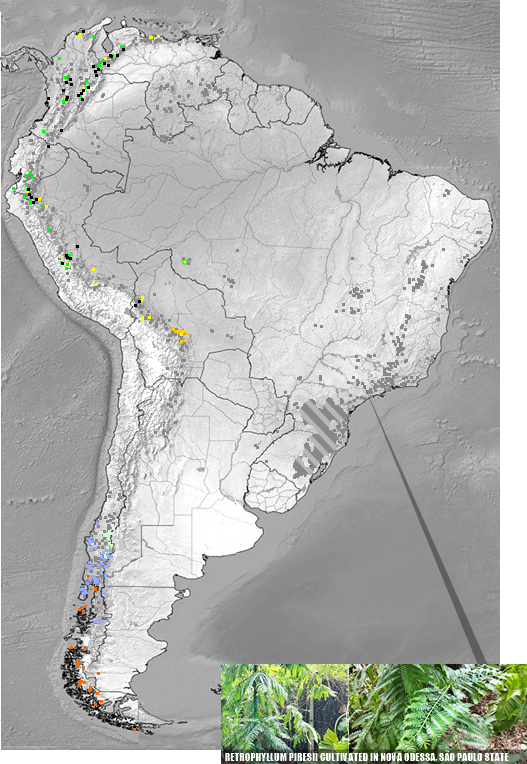
| ■ Prumnopitys montana |
| ● Retrophyllum rospiglosii |
| ■ Retrophyllum piresii |
| ● Pectinopitys harmsiana |
| ■ Pectinopitys exigua |
| ● Podocarpus spp. |
| ■ Prumnopitys andina |
| ● Saxegothaea conspicua |
| ■ Lepidothamnus fonkii |
PODOCARPACEAE GENERA IN SOUTH AMERICA
SOUTH AMERICAN GENERA BY TAXONOMIC ORDER
In South America, Pectinopitys, Prumnopitys, and Retrophyllum each have a single species in the tropical Andes, from Venezuela to Peru, and each has one outlier, all disjunct nationally, namely Pectinopitys in Bolivia, Retrophyllum in Brazil, and Prumnopitys in Argentina and Chile. The only exception to this symmetry is that the Andean Pectinopitys also reaches Bolivia. Saxegothaea and Lepidothamnus occur only in Argentina and Chile, while Podocarpus co-occurs with all the other genera.
LEPIDOTHAMNUS
Trees, shrubs or creepers with narrow, linear spreading juvenile leaves giving way by gradual transition to strongly keeled, subulate, decurrent appressed scales. Three spp., two in New Zealand and one in South America.
Lepidothamnus fonkii Phil.
A densely branched, usually prostrate shrub up to 60 cm tall, known from Argentina (Chubut, Neuquén, and Rio Negro) and Chile (Aisén, Los Lagos, and Magellanes), in moorland and bogs at 0-1150 m elevation (TGD).
PECTYNOPITYS
Trees. Six spp., Australia, New Zealand and New Caledonia one each, one from Costa Rica, and two in South America.
Pectinopitys exigua (de Laub.) C.N.Page
Trees to 20 m tall, known at 1850-3000 m from Cochabamba, Chuquisaca and Santa Cruz in Bolivia, in upper montane evergreen rainforests rich in epiphytes (TGD).
Pectinopitys harmsiana (Pilg.) C.N.Page
Trees to 35 m, in mountain areas of Venezuela, Colombia, Ecuador, Peru, and Bolivia, at elevations of (1,000)1500-2,200(-2,800) m (TGD).
PRUMNOPITYS
Trees, densely branched dioecious to 60 m tall. Three spp., one in New Zealand and two in South America.
Prumnopitys andina (Poepp. ex Endl.) de Laub.
Trees to 21 m tall, mainly in SC & S Chile, sometimes alleged to occur in Neuquén province of Argentina, but no specimens have been confirmed to that provenance, and specimens in the field are often confused with Saxogothaea conspicua, however is accepted here (TGD).
Prumnopitys montana (Humb. & Bonpl. ex Willd.) de Laub.
Trees to 30 m tall, NW Venezuela to N Peru, at elevations of 1500-3600 m (TGD).
SAXEGOTHAEA
A single species.
Saxegothaea conspicua Lindl.
Monoecious evergreen trees to 25 m tall with one or multiple stems and long branches forming a rounded crown, known from SC & S Chile to S Argentina (TGD).
PODOCARPUS
Shrubs and trees to 50 m tall, dioecious (rarely monoecious), evergreen, leaves alternate, linear to ovate, usually with a single midvein and rarely with parallel veins, bearing resin canals, but wood does not. Male cones axillary, cylindrical, typically borne in groups in zones along the twig. Female cones axillary; receptacle naked or composed of 2-5 bracts, of which the upper 1-2 bracts are sterile and in most species swell greatly to form a succulent, often brightly-colored (orange, red or purple) receptacle.
Podocarpus is a pantropical group comprising 116 species, with 33 species in the Americas, distributed from Mexico and Cuba to the southernmost parts of Argentina, with diversity slightly concentrated in Cuba and northwestern South America; 4 species in continental Africa, from Sudan and Nigeria to South Africa; 5 species in Madagascar; and 74 species across the Asia–Pacific region. New Guinea and New Caledonia each harbor approximately 8 endemic species, whereas only 7 species occur in Australia. Nine species reach China.
33 species of Podocarpus occur in the New World, with endemic in Cuba (4, P. angustifolius, P. aristulatus, P. ekmanii, and P. victorinianus), Jamaica (2, P. purdieanus and P. urbanii), Hispaniola (2, P. buchii and P. hispaniolensis), Costa Rica (1, P. costaricensis), and Trinidad and Tobago (1, P. trinitensis). Two species have broader distributions but are not native to South America, namely P. coriaceus, which occurs from Puerto Rico to Trinidad and Tobago, and P. matudae, which ranges from Mexico to El Salvador. The remaining 21 species occur in South America. Among these regions, Cuba has the highest number of endemic species (4). All South American members are restricted of continent except P. guatemalensis and P. oleifolius which reaches up to Mexico, and P. magnifolius up to Panama.
Here, we aim to establish a consensus distribution for each species based on the main references, although some sources show considerable discrepancies. GBIF, for example, includes records of cultivated plants, which may reduce the accuracy of the reported distributions. In addition, some species are particularly problematic, especially the Brazilian species P. brasiliensis, P. lambertii, P. sellowii, and P. transiens.
Internationally, the species generally reported for Brazil are recognized in a similar manner, except for our inclusion of P. roraimae in Brazil and our rejection of P. barretoi. Podocarpus barretoi Laubenf. & Silba is cited in Reflora, absent in POWO, GBIF and Farjon. Species Link placed P. barretoi in Goiás and Minas Gerais state. Here we accept P. barretoi as a synonym of P. brasiliensis, as stated in POWO.
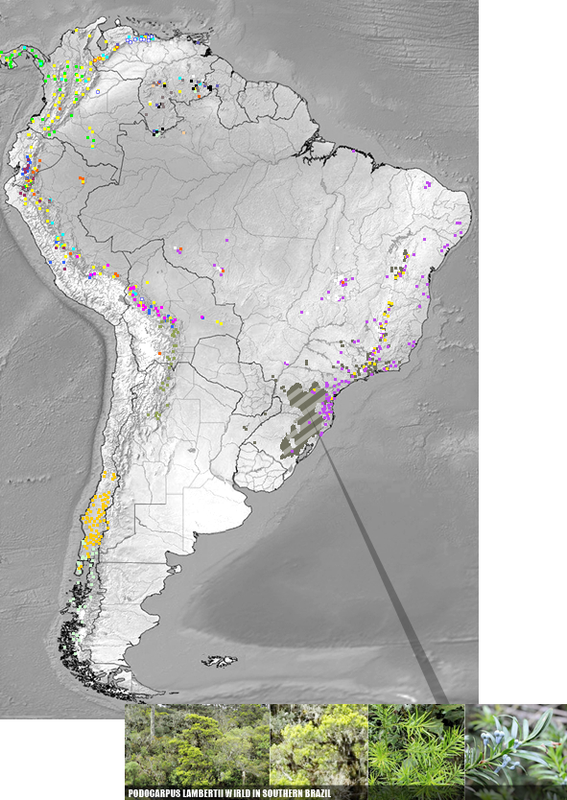
| ■ Podocarpus guatemalensis |
| ● Podocarpus oleifolius |
| ■ Podocarpus steyermarkii |
| ● Podocarpus tepuiensis |
| ■ Podocarpus roraimae |
| ● Podocarpus aracensis |
| ■ Podocarpus acuminata |
| ● Podocarpus pendulifolius |
| ■ Podocarpus salicifolius |
| ● Podocarpus celatus |
| ■ Podocarpus brasiliensis |
| ● Podocarpus transiens |
| ■ Podocarpus sellowii |
| ● Podocarpus lambertii |
| ■ Podocarpus magnifolius |
| ● Podocarpus glomeratus |
| ■ Podocarpus sprucei |
| ● Podocarpus rusbyi |
| ■ Podocarpus parlatorei |
| ● Podocarpus salignus |
| ■ Podocarpus nubigenus |
PODOCARPUS FROM SOUTH AMERICA
In these terms, we confirm 8 species in Brazil here. National diversities, from greatest to least, are namely Venezuela (13, 1ᴱ), Brazil (8, 2ᴱ), Bolivia (8), Peru (8), Ecuador (7), Colombia (5), Argentina (3), Chile (2, 1ᴱ) and Guyana (2). Podocarpaceae in Brazil needs a urgent revision!
Podocarpus acuminatus de Laub.
Small trees 4-5 m tall, known from Serra da Neblina in Amazonas in NW Brazil, and Sierra de Neblina and Chimantá, SW Amurítepui in Bolivar state, Venezuela, growing as an exposed tree in cloud forests and among rocks, at 1,900-2,400 m (TGD).
SpeciesLink, GBIF, and Farjon report the same two collections; however, GBIF reports two collections in Panama, both rejected here. Reflora reports the species in Amazonas, a concordant record (SEE).
Podocarpus aracensis de Laub. & Silba
Shrubs or trees to 6 m tall, on tepuis, along streams in shrubby vegetation or dwarf forest, in Serra do Araçá and possibly Mount Neblina in Amazonas state in Brazil, and Cerro Yavi and Murey Tepui in Macizo del Chimantá, Venezuela, at elevations of circa 1200 m in Brazil and 2100 m in Venezuela (TGD | Farjon). Concordant range in Reflora.
GBIF map fully rejecyed here. Not cited in SpeciesLink.
Podocarpus brasiliensis de Laub.
Trees to 15 m tall, at 800-1600 m elevation, primarily in savannas from C Brazil (cerrado), and in dwarf forest on the tepuis of Venezuela.
Podocarpus brasiliensis is a species with a highly conflated distribution. Out of the 6 main references, there is consensus only for Goiás, Distrito Federal, and Mato Grosso. Farjon, GBIF, and SpeciesLink provide good options for pinpointing records. Farjon and TGD exclude Paraná and include Roraima, although Farjon does not map Roraima. São Paulo is only mentioned by SpeciesLink for a record in Guaratinguetá; Tocantins is cited in GBIF; Amazonas is mentioned only by SpeciesLink for the NW region; and Rondônia is only mentioned by Farjon, with a record in Pacaás Novos. Bahia is mentioned by all except Reflora and LC Marinho (Sitientibus, 2016). Bahia, Minas Gerais, Roraima, Paraná, São Paulo, and Rondônia are the conflicting states.
The record from Tocantins, SW Goiás and E Mato Grosso do Sul, all from GBIF, are accepted here.
The record from São Paulo in Guaratinguetá is accepted here.
The record in Rondônia, indicated only by Farjon, GBIF and TGD, are accepted here.
The record in Paraná, the same in Species Link and GBIF, in Piraquara, was previously considered P. sellowi, changed to P. brasiliensis in 1988 by Cope. Due to the extreme inconsistency of the standard distribution, we consider it as P. sellowi here.
The record in Amazonas, cited only in Species Link, is rejected here due to its extreme inconsistency with the other records of the species.
The record in Roraima is rejected here because it was only cited in Farjon and TGD, and it wasn't even mapped in the first reference.
Here we accept the records from Minas Gerais, a mix of GBIF, Species Link, and Farjon, relatively consistent, plus cites of P. barretoi.
For Bahia, we also accept here a mix of GBIF, Species Link, and Farjon, despite the exclusion of this species in LC Marinho (Sitientibus, 2016).
Podocarpus celatus de Laub.
Trees to 30 m tall, known in Venezuela (Amazonas, Bolivar, Tachira), Colombia, Ecuador, Peru (Amazonas, Junin, Loreto, Montaña, Puno), Bolivia (Potosí), Brazil (Rondonia, Mato Grosso and Mato Grosso), at elevations of 350-1400 meters in lowland to low montane tropical evergreen rainforest.
For P. celatus, out of the six main references, TGD includes the species in Mato Grosso and Goiás; POWO probably follows this interpretation; GBIF shows the distribution only in Rondônia (some South America record rejected here); Reflora distributes it across Rondônia, Mato Grosso, and Goiás; the map in Farjon highlights only Rondônia and Goiás; and SpeciesLink only reports it for Rondônia. Mato Grosso is mentioned in Farjon but is not mapped.
Thus, its validation in Mato Grosso is based solely on what is registered in Species Link: a record from 1961, 35 km from Vilhena. Based on these texts, we consider here that P. celatus occurs in three points in Brazil, in Pacaas Novos (RO), NW Mato Grosso, and northern Goiás state.
Podocarpus glomeratus D.Don
Trees to 12 m tall, mostly as single trees or in small groves in cloud forest and montane rainforest at (1,800-)2,500-3,600(-4,000) m elevation in Andes from Ecuador, Peru and Bolivia (TGD | POWO | GBIF | Farjon).
Not cited in SpeciesLink or Reflora.
Podocarpus guatemalensis Standl.
Trees, dioecious, to 45 m tall, occurring from 0 to 1000 m on deep brown soils and siliceous soils derived from granite and volcanic rocks. Reported from Mexico to Colombia, absent from Ecuador and doubtful in Venezuela in both POWO and TGD; reported from Mexico to Ecuador and Venezuela in GBIF and Farjon. Here, we follow the broader distribution of the species.
Not cited in SpeciesLink or Reflora.
Podocarpus lambertii Klotzsch ex Endl.
Tree to 12 m tall, at elevations of 900–1800 m, mainly in western Santa Catarina in the Atlantic Forest and Pampa biomes, but also in a relatively small and disjunct area of suitable habitat in the Caatinga biome in southern Bahia state, and in some patches of rocky grasslands (campos rupestres) SE & S Brazil to Misiones in NE Argentina (TGD).
The non-mapped sources Reflora and TGD, the partially mapped LC Marinho et al. (Sitientibus, 2016) and the mapped GBIF are consistent from range from Bahia to Rio Grande do Sul also Minas Gerais, except form Espirito Santo, recognized only in Reflora and LC Marinho (Sitientibus, 2016). In Farjon and POWO, P. lambertii has a narrower distribution, only for São Paulo, Paraná, Santa Catarina and Rio Grande do Sul, and border of Minas Gerais. Records from Species Link are highly consistent with all previous data except for not including Espírito Santo, expanding well beyond Farjon, and including records in Mato Grosso do Sul (a single record in Iguatemi), Goiás (5, 4 in Trindade and one in Alto Paraiso de Goias), and the Distrito Federal (3 very inconclusive records).
We follow the data from Farjon (2013), GBIF, and Species Link, excluding the records from Espírito Santo, Goiás and the Distrito Federal.
Podocarpus magnifolius J.Buchholz & N.E.Gray
Tree 10-25 m tall, distribution is highly consistent across the various references (GBIF | Farjon | TGD | POWO), from Panama to Bolivia and Venezuela, except in Ecuador, with the exception of an extremely erroneous record from São Paulo, Brazil, highlighted in GBIF.
Not cited in SpeciesLink or Reflora.
Podocarpus nubigenus Lindl.
Trees to 25 m tall, dioecious, known in Argentina (Nequen, Santa Cruz) and Chile (Aisen, Los Lagos, Magellanes), at elevations of 0-1000 m (TGD | GBIF, rejected here | Farjon | POWO).
Not cited in SpeciesLink or Reflora.
Podocarpus oleifolius D.Don
Trees to 30 m tall, erect, with a single, round trunk, densely branched; probably the most widespread and common Podocarpaceae in the Western Hemisphere, known from Mexico (Guerrero, Chiapas, Michoacán, Oaxaca, Veracruz, Puebla), Guatemala, El Salvador, Honduras, Costa Rica, Panama, Venezuela, Colombia, Ecuador, Peru, and Bolivia (TGD | POWO | Farjon | GBIF), occurring at sites close to Brazil in both Venezuela and Bolivia, but absent from the country.
Not cited in SpeciesLink or Reflora.
Podocarpus parlatorei Pilg.
Shrubs, or trees to 20 m tall, found in montane Yungas forests at elevations of 1200–3000 m, in C & EC Bolivia to NW Argentina (TGD | GBIF | Farjon). Some of the westernmost records in GBIF are rejected here.
Not cited in SpeciesLink or Reflora.
Podocarpus pendulifolius J.Buchholz & N.E.Gray
Dioecious trees to 20 m tall, only known from the Cordillera do Merida, where found at 1400–3000 m elevation, in NW Venezuela (TGD | Farjon | GBIF).
Not cited in SpeciesLink or Reflora.
Podocarpus roraimae Pilg.
Shrubs, or small trees to 10 m tall, known from Mount Roraima in W Guyana and Venezuela in several isolated peaks in Amazonas and Bolivar, in sandstone tepuis at elevations of 1800-2700 m (TGD | POWO | Farjon | GBIF).
Several international references do not include Podocarpus roraimae in Brazil, but highlight its occurrence in border mountain ranges, such as Pico da Neblina and Monte Roraima. Reflora cites the species for the states of Amazonas and Roraima, consistent with its occurrence in these mountain ranges. SpeciesLink documents at least one confirmed occurrence on the Brazilian side, at 2,400 m elevation. For this reason, we accept the species as validly occurring in Brazil.
Podocarpus rusbyi J.Buchholz & N.E.Gray.
Trees to 25 m tall, known in Bolivia (Cochabamba, La Paz, and Santa Cruz) and Peru (Cuzco and Machu Pichu), in tropical montane rainforest and high montane cloud forest at elevations of 700-3350 m (Farjon | POWO | GBIF | TGD).
Not cited in SpeciesLink or Reflora.
Podocarpus salicifolius Klotzsch & H.Karst. ex Endl.
The species is not cited for Brazil by Reflora, Farjon, SpeciesLink, or GBIF. POWO cites it for northern Brazil, in addition to Venezuela, Colombia, Peru and Bolivia, while TGD gives a distribution including Bolivia, Brazil, Colombia, Peru, and Venezuela, although with no records from Brazil or Peru, suggesting that the reported range is optimistic. In this context, we follow exclusively the distribution proposed by Farjon, restricted to Venezuela, Colombia, and Bolivia.
Podocarpus salignus D.Don
Dioecious trees to 20 m tall endemic to Biobio, La Araucania, Los Lagos, Maule, at 20-1200 m elevation on soils derived from siliceous rock types in SC & S Chile (TGD, POWO, GBIF and Farjon).
Not cited in SpeciesLink or Reflora.
Podocarpus sellowii Klotzsch ex Endl.
Shrubs or trees to 20 m tall, with an extremely broad and scattered range, occurring in montane vegetation, north to Amazonas, Pernambuco and Ceará, south to Rio Grande do Sul, also west to Rondonia, Mato Grosso and Mato Grosso do Sul state (TGD).
Podocarpus sellowii is problematic in terms of its reported distribution. Plants of the World Online (POWO) and Farjon recognize the species from Rio de Janeiro to Rio Grande do Sul. Global Biodiversity Information Facility (GBIF) provides a much broader, probably highly erroneous distribution, with implausible records extending as far as Bolivia, as does SpeciesLink. Reflora also provides an exceptionally broad distribution, citing the species for Acre, Pará, Rondônia, Alagoas, Bahia, Ceará, Pernambuco, Sergipe, Distrito Federal, Goiás, Mato Grosso, Mato Grosso do Sul, Minas Gerais, and Espírito Santo. The species is also cited for Pará and Rondônia by Mainieri & Pires (Silvicultura em São Paulo, 1973), and mapped and cited for Bahia by LC Marinho (Sitientibus, 2016).
Here, records from Maranhão in GBIF and SpeciesLink are rejected because they do not belong to Podocarpaceae, but rather to Amaranthaceae. Records from Ceará follow a combined assessment of GBIF and SpeciesLink, excluding cultivated records. In Pernambuco, only the GBIF and SpeciesLink records from Caruaru are accepted, as the records from Recife correspond to cultivated material, while those from Rio Formoso belong to Conocarpus erectus. Records from Alagoas and Sergipe are fully accepted based on both GBIF and SpeciesLink. Records from Bahia to Rio Grande do Sul in GBIF and SpeciesLink are also fully accepted here, except for those from the city of Salvador.
This species has two varieties.
Podocarpus sellowii var. angustifolius Pilg., known from two districts of Rio de Janeiro state, Cerro dos Orgãos and Pico do Tingua.
Podocarpus sellowii var. sellowii, remaining distribuiton of species.
Podocarpus sprucei Parl.
Trees to 20 m tall from C Ecuador to C Peru (GBIF, POWO, Farjon), at elevations of 1,800 to 3,900 m, which corresponds to high montane and subalpine forests (TGD).
Not cited in SpeciesLink or Reflora..
Podocarpus steyermarkii J.Buchholz & N.E.Gray
Tree to 25 m. Venezuela and W Guyana in GBIF, Farjon and POWO, however not yet known from the Guianas but definitely to be found, as specimens from tepuis in Venezuela near the border with Guyana are known (TGD). Despite its occurrence in Venezuelan side of Mount Neblina, there is no reliable record of its presence in the Brazilian part of this tepui.
Not cited in SpeciesLink or Reflora.
Podocarpus tepuiensis J.Buchholz & N.E.Gray
Shrub to small tree 2-10 m tall. S Venezuela at 950-2100 m and SE Ecuador in POWO and Farjon. Reported from Venezuela, Ecuador and Peru in GBIF and Species Link, accepted here in these three countries. Assignated as endemic to Venezuela in TGD.
Not cited in SpeciesLink.
Podocarpus transiens (Pilg.) de Laub.
Tree to 12 m tall, with a rounded or irregular crown of spreading branches, known from E Brazil, former Podocarpus lambertii var. transiens Pilg. This species is virtually identical to the description of Podocarpus lambertii, differing primarily in leaf width, being more than 4 mm instead of less than 4 mm, a character of doubtful taxonomic importance (TGD).
P. transiens is cited for four regions in POWO; not recognized in LC et al. (Sitientibus, 2016); BA, MG, PR and SC in GBIF; BA, MG, SP, RJ, PR and SC in Species Link; BA, MG and GO in Farjon, no mapped records in Paraná and Santa Catarina states; BA, MG and SC in Reflora; and BA (Morro do Chapeu), GO, MG (Serra do Cipó, Serra de San José), PR and SC states in TGD.
RETROPHYLLUM
Dioecious trees or shrubs; bark exfoliating in short vertical strips or small pieces, or as large plates. Six species, four in Oceania and two in W tropical South America. The two South American species also appear to be ecologically separated, with R. piresii inhabiting lowland swamp forest at altitudes of less than 1000 m and R. rospigliosii normally occurring in montane and cloud forests, nearly always above 1500 m (RR Mill, Edinburgh Journal of Botany, 2016).
Graham (2008) documented the discovery of an unidentified Retrophyllum species from humid lowland swamp forest at Madre Selva Biological Station near Iquitos, Peru (Mongabay). Two male trees were found but at that time no females, and so the field botanists could not determine whether it was a new species, although it appeared to be different from R. rospigliosii. The photograph published in Graham (2008) shows a tree with leaves similar to those of R. piresii in their elliptic outline. One female tree has since been found, as well as at least 20 seedlings and other mature trees, all over 30 m tall. However, no herbarium material of this enigmatic taxon has been seen, and it is not known whether any exists. Cones from the single known female tree need to be collected to determine whether this taxon is conspecific with Brazilian R. piresii or represents a third South American species of the genus (RR Mill, Edinburgh Journal of Botany, 2016).
Two additional collections (Neill & Salinas 7202; Morales et al. 867), both from W Ecuador, represent specimens combining characteristics of the two described species. These are provisionally treated here as forms of the Andean species pending further taxonomic assessment. Another specimen [Peru. Puno: 13°30′S, 69°50′W, 870 m] is also problematic. It occurs at a rather low elevation for Retrophyllum rospigliosii, and its branches are opposite, as in R. piresii. However, its true taxonomic status remains uncertain (RR Mill, Edinburgh Journal of Botany, 2016).
Retrophyllum piresii (Silba) C.N.Page.
Tree, evergreen, up to 30 m tall and up to 2.5 m dbh, adult tree branching at 15 m above base, known only from Serra dos Pacaas Novos in Rondônia state, WC Brazil.
In August 1976, during a trip undertaken by the late Dr. João Murça Pires, accompanied by William Antônio Rodrigues as his tour companion and the botany parataxonomist Nelson Rosas, they visited the Serra dos Pacaás Novos region, Rondônia, with the strategic support of a helicopter kindly provided by Projeto RADAMBRASIL. In a clearing previously opened by RADAMBRASIL for floristic prospecting and ecological studies, in the middle of the forest at Seringal São Luiz, 50 km east of the Pacaás Novos River, they managed to collect some exsiccates from a large gymnosperm tree (30 × 0.60 m). Most of the material was later described by Silba (1983) as Decussocarpus piresii, a name subsequently used as the basionym for Nageia piresii (Silba) de Laub. in 1987 and, more recently, for Retrophyllum piresii (Silba) C. N. Page in 1989.
Only a single tree of the species was found at the site, and it was fruiting at the time. Some seeds were collected by Dr. Murça Pires and, after germination, were introduced into the garden of the Emílio Goeldi Museum in Belém, Pará. Two of these seedlings are growing well and currently measure around 5 m tall, constituting rare cultivated specimens of the species outside its natural habitat.
Currently, only five specimens of this tree are known, namely the type (a female specimen with ripe cones, represented in several herbaria) and two other wild-collected specimens as well, one the plant cultivated in Belém, Pará, and a clone of the latter growing at Jardim Plantarum in Nova Odessa, São Paulo state (youtube.com/watch?v=F1D-XLk5fzw). This is probably the rarest conifer in the southern Hemisphere and perhaps one of the rarest in the world.
Retrophyllum rospigliosii (Pilg.) C.N.Page.
W Venezuela (Táchira, Mérida, Trujillo), E Colombia (Antioquia, Cundinamarca, Magdalena, Norte de Santander, Santander del Sur), Ecuador (Napo, Sucumbios, Zamora-Pichanque), NW & C Peru and NE Bolivia (La Paz), in montane forests, cloud forest; (600–)1500–3750 m (RR Mill, Edinburgh Journal of Botany, 2016).
The three records from below 1000 m relate to the three atypical specimens from Ecuador and Peru, all of which have some features of Retrophyllum piresii.
CUPRESSALES
4 families, mainly from northern Hemisphere except Cupressaceae, slightly diverse in Australia, New Zealand, New Caledonia, southern Africa, Argentina and Chile. All species in the order are woody plants; they range from small shrubs to the largest trees in existence.
CEPHALOTAXACEAE
8 spp. in a single genus, Cephalotaxus, from Tibet to Vietnam, Korea and Japan.
SCIADOPITYACEAE
A single species, Sciadopitys verticillata (Thunb.) Siebold & Zucc., endemic to Japan in S Honshu, Shikoku and Kyoshu islands (JRP Worth et al, Biological Journal of the Linnean Society, 2012).
TAXACEAE
5 genera, namely Amentotaxus (7, China to Cambodjia, Taiwan) and Pseudotaxus (1, SE China) from Asian; Austrotaxus (1, New Caledonia) from southern Pacific; and two are Asian/America, Taxus (13, 8 in Eurasia, from Afganisthan and Tibet to Sumatra, Sulawesi, and SE Russia, 1 from Alaska to California, 1 from SE Canada to E USA, 1 from Mexico to Honduras, 1 disjunct from Mexico and Florida, 1 in Europe to W Russia, Algeria and Iran) and Torreya (7, 5 in China, Korea and Japan, 1 in California, 1 in SE USA).
CUPRESSACEAE
A family with 30 genera and 167 spp., in six lineages, two most basal in Asia (2/3), the next two disjuncts in Japan, China, Laos, Vietnan, USA, Mexico, Guatemala and Tasmania in Australia (7/8), and two super irradiations, Cupressoideae in northern Hemisphere (13/122, c. 3/5 of diversity in Juniperus), and Callitroideae in Australaisia, Africa and southern South America (8/34, 20 in Callitris).
NORTH AMERICA AND OLD WORLD (4) — Thuja (5, 1 in Alaska to Califormia, 1 in E USA, 3 in C China to Japan and Korea), Chamaecyparis (5, 3 in Japan and Taiwan, 1 in W USA, 1 in E USA), Calocedrus (4, 3 from China to Vietnam and Thailand, 1 from W USA to NW Mexico) and Juniperus (69, Canada to Guatemala, Africa, Eurasia); WIDELY OLD WORLD (1) — Cupressus (15, NW & C Sahara, E Mediterranean to C China and N Vietnam); MEDITERRANEAN (1) — Tetraclinis (1, Morocco to Lybia, Spain, Scily in Italy); AFRICA (1) — Widdringtonia (4, Malawi to South Africa); E ASIA (10) — Microbiota (1, Russian Far East), Thujopsis (1, Japan), Cryptomeria (1, China and Japan), Taiwania (1, Tibet to Vietnam and Taiwan), Metasequoia (1, SE China), Xanthocyparis (2, SE China to N Vietnam), Fokienia (1, S China, Laos, Vietnam), Cunninghamia (2, S China, Laos, Thailand, Vietnam), Glyptostrobus (1, S China, Laos, Vietnam), and Platycladus (1, Russian Far East to EC China and Korea); AUSTRALASIA TO NEW ZEALAND (5) — Papuacedrus (1, Halmatera to New Guinea), Callitris (20, Australia, New Caledonia), Diselma (1, Tasmania), Athrotaxis (2, Tasmania), and Libocedrus (5, New Caledonia, New Zealand); NORTH AMERICA (5) — Callitropsis (1, S Alaska to NW California), Sequoia (1, SW Oregon to W California), Sequoiadendron (1, California), Taxodium (1, C & E USA to Guatemala), and Hesperocyparis (17, W & SC USA to Nicaragua).
Three genera and species in South America, all from SC & S Chile to S Argentina.
Austrocedrus chilensis (D.Don) Pic.Serm. & Bizzarri
Dioecious trees, evergreen, with a short trunk and narrow crown, known from C & SC Chile to SW Argentina, the most northerly distributed conifer species of the Andean Patagonian forest (TGD).
Fitzroya cupressoides (Molina) I.M.Johnst.
A very large evergreen tree, normally growing to 40-60 m tall and up to 5 m in trunk diameter, known from Chile (Los Lagos) to SW Argentina (TGD). Fitzroya is tetraploid, a highly unusual condition in conifers, which are almost all diploid (with the exception of hexaploid Sequoia).
Pilgerodendron uviferum (D.Don) Florin
Dioecious shrubs and trees to 20 m tall, known from S Chile to S Argentina (TGD). This is probably the southernmost conifer in the world (the second most southerly is Lepidothamnus fonkii, also in Chile, and one of the smallest of all conifers).
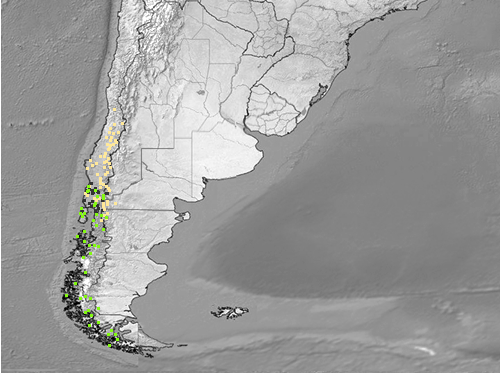
| ▪ Austrocedrus chilensis |
| ▪ Fitzroya cupressoides |
| ▪ Pilgerodendron uviferum |
CUPRESSACEAE FROM SOUTH AMERICA
ANGIOSPERMAE
SSAA